1

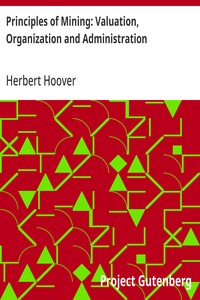
Principles of Mining: Valuation, Organization and Administration — Text and Context
(0 User reviews)
2776
Project Gutenberg
2008
Not confirmed
Mines and mineral resources; Mining engineering; Mineral industries -- Finance
Readers of public-domain and historical texts
Project Gutenberg digital edition
en
Edition facts
Words
61,201
Reading time
267 min
Text sections
8
Principles of Mining: Valuation, Organization and Administration — Text and Context can be approached with a clearer sense of reading commitment from its source measurements: 61,201 words, 4 hr 27 min estimated reading time, and 8 detected text sections.
The text analysis averages about 20.3 words per sentence, while the detected sections provide another way to judge how the source is divided.
Project Gutenberg metadata also associates the work with “Mines and mineral resources,” connecting these edition facts with the source record’s subject description.
Source:
Project Gutenberg record #26697
Herbert Hoover's 1909 mining manual examines valuation, organization, and administration of copper, gold, lead, silver, tin, and zinc mines, with precise technical language and systematic methods for sampling, ore classification, and stope support.
Read the complete public-domain text at its original source.
Read on Project GutenbergHerbert Hoover's Principles of Mining opens with a preface that situates the work as a condensation of lectures delivered at Stanford and Columbia Universities, intended for readers with some mining knowledge but not long experience. Hoover acknowledges that the bulk of material is 'the common heritage of the profession' and traces mining science back to 'unnamed Egyptian engineers' six thousand eight hundred years ago. This historical grounding sets a tone of humility and cumulative expertise, while the book's structure—chapters on valuation, development, and administration—reflects a systematic approach to the field.
Precision in Sampling and Assay Plans
Hoover devotes early chapters to the determination of average metal content, detailing sampling methods, assay plans, and calculations of averages. He explicitly addresses the 'percentage of errors in estimate from sampling,' a concern that reveals the practical stakes of valuation. The language is technical and procedural: 'sampling, assay plans, calculations of averages' are presented as sequential steps. Hoover does not assume perfect knowledge; instead, he quantifies uncertainty, a hallmark of engineering rigor. The emphasis on error margins distinguishes this work from simpler guides, as it prepares the reader for the inherent variability in ore deposits.
Classification of Ore in Sight
A key distinction in Hoover's valuation method is the classification of ore 'in sight' versus prospective ore. He calculates quantities and categorizes reserves based on physical exposure, not speculation. The text moves methodically from 'calculation of quantities of ore' to 'classification of ore in sight,' establishing a hierarchy of certainty. This classification directly influences financial decisions, as only ore in sight can be reliably valued. Hoover's diction—'ore in sight,' 'prospective value'—reflects a cautious, evidence-based approach. He avoids overpromising, instead grounding estimates in observable data from development work.
Stope Support and the Rill Method
In the excerpt on stope support, Hoover describes timber constructions like cribs—'a "log-house" sort of structure usually filled with waste'—and the increasingly popular system of filling excavations with waste. He advocates for the 'rill-stope' method, where waste flows by gravity, calling its advantages 'so patent as to make it difficult to understand why they are not universally adopted when the dip permits.' The description is precise: winzes should be placed on the hanging-wall side, and filling poured down reaches the foot-wall with 'a minimum of handling.' Hoover's voice is that of a practitioner who values efficiency and has observed the practical benefits firsthand.
Recoverable Percentage and Cost of Production
Hoover's valuation framework includes 'recoverable percentage of the gross assay value,' 'price of metals,' and 'cost of production.' These factors translate geological estimates into financial reality. He also addresses 'redemption or amortization of capital and interest,' treating mining as a long-term investment. The language is unadorned: 'price of metals' and 'cost of production' are variables to be calculated, not speculated upon. This section underscores the book's purpose as a practical manual for engineers and investors, not a theoretical treatise. Hoover's systematic breakdown—from sampling to amortization—mirrors the sequential logic of a feasibility study.
Hoover's Principles of Mining rewards careful reading of its technical passages, where the author's engineering judgment is most apparent. Readers interested in the history of mining practice will find a clear, methodical exposition of early twentieth-century methods, while those seeking insight into Hoover's own analytical habits will note his insistence on quantifiable data and his respect for the profession's cumulative knowledge. The book stands as a document of its time, reflecting both the state of mining engineering and the author's disciplined approach to problem-solving.
I keep thinking about how Hoover’s manual treats a mine like something alive—each ore body with its own temperament, needing patient measurement before any decision. It reminded me of how Records of a Family of Engineers — Context and Discussion traces a different kind of inheritance, where the real machinery is human habit, passed down quietly through generations. Both left me feeling oddly tender toward things we usually call technical.
There are no reviews for this eBook.
There are no comments for this eBook.
Reader reflection
Take a moment to reflect on this book
Create a short personal record of your experience with this book.
Your progress
0
/
10
2
Did this book hold your interest?
3
Would you encourage someone else to read it?
4
How demanding did the text feel?
5
Did anything about the book feel genuinely new?
6
How useful were the ideas in this book?
7
What was its emotional impact?
8
Is this a title worth rereading?
9
What did this book teach you most?
10