1

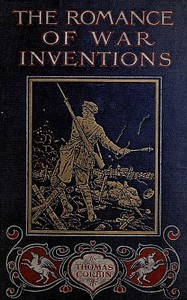
The Romance of War Inventions A Description of Warships, Guns, Tanks, Rifles, Bombs, and Other Instruments and Munitions of Warfare, How They Were Invented & How They — Background and Themes
(0 User reviews)
947
Project Gutenberg
2010
Not confirmed
Military art and science; Naval art and science; Inventions
Readers of public-domain and historical texts
Project Gutenberg digital edition
en
Edition facts
Words
91,629
Reading time
399 min
Text sections
11
The catalog record for The Romance of War Inventions A Description of Warships, Guns, Tanks, Rifles, Bombs, and Other Instruments and Munitions of Warfare, How They Were Invented & How They — Background and Themes provides practical reading context through 91,629 words, 6 hr 39 min estimated reading time, and 11 detected text sections.
The text analysis averages about 20.9 words per sentence, while the detected sections provide another way to judge how the source is divided.
Project Gutenberg metadata also associates the work with “Military art and science,” connecting these edition facts with the source record’s subject description.
Source:
Project Gutenberg record #34459
An examination of Thomas W. Corbin's descriptive choices in explaining early 20th-century military technology, focusing on his use of mechanical analogy, step-by-step explanation, and the tension between technical precision and accessible language.
Read the complete public-domain text at its original source.
Read on Project GutenbergThomas W. Corbin's The Romance of War Inventions (1910) opens with a striking juxtaposition: the book's title promises romance, yet its first substantive excerpt describes the four-stroke cycle of a Diesel engine with the methodical precision of a technical manual. This tension between the allure of invention and the grit of mechanical detail defines Corbin's authorial voice. He writes not as a historian or journalist, but as an explainer—someone who believes that the wonder of a weapon lies in understanding how it works. His prose moves from the concrete (a piston's downstroke) to the abstract (the cycle of operations), often using analogies drawn from everyday experience, such as comparing a Gnome engine's cylinders to the spokes of a wheel. These choices reveal a writer committed to demystifying technology for a general audience, yet one who never sacrifices accuracy for simplicity.
Diction: Technical Terms and Their Framing
Corbin's vocabulary oscillates between specialized jargon and plain English. He uses terms like "connecting-rods," "crank," and "flywheel" without definition, assuming a baseline mechanical literacy. Yet when introducing the Diesel engine's cycle, he carefully labels each stroke: "First comes a downstroke, drawing in air: then an upstroke, compressing it." This step-by-step enumeration mirrors instructional writing. Notably, he avoids metaphorical language for the engine's operation—there is no "heartbeat" or "breath"—preferring literal description. The word "cycle" itself is repeated, emphasizing the repetitive, predictable nature of the machine. When describing the Gnome engine's unique rotating cylinders, Corbin shifts to a spatial analogy: "cylinders arranged around a centre like the spokes of a wheel." This is one of the few figures of speech in the excerpt, and it serves to clarify an unfamiliar configuration. His diction thus balances precision with accessibility, never patronizing the reader but occasionally offering a visual anchor.
Voice: The Explainer's Stance
Corbin adopts a consistently instructive tone, using second-person address sparingly but effectively. In the Diesel engine passage, he writes "the cylinder is cleaned out ready for a fresh supply of pure air to be drawn in," using the passive voice to focus on the process rather than the operator. When explaining starting difficulties, he states "such an engine cannot develop power until it has accomplished at least four strokes," a declarative sentence that conveys certainty. The voice is authoritative but not pedantic; Corbin assumes the reader is curious and capable. He occasionally inserts clarifying asides: "Power, it will be noticed, is only developed in one out of the four strokes." This parenthetical remark guides attention without breaking the explanatory flow. The overall effect is that of a patient tutor who anticipates confusion and addresses it preemptively. There is no rhetorical flourish or emotional appeal—the romance, for Corbin, lies in the ingenuity of the mechanism itself.
Structure: The Anatomy of Explanation
Corbin organizes his explanations in a logical, almost procedural sequence. The Diesel engine description follows a clear temporal order: first the downstroke, then the upstroke, then the power stroke, then the exhaust. He uses transitional phrases like "Thus" and "From the very nature of its working" to connect steps. When discussing multi-cylinder engines, he introduces a conditional: "if there are four cylinders, there is always power being developed by one of them." This hypothetical example concretizes an abstract advantage. The structure mirrors the mechanical cycle it describes—repetitive, cumulative, and designed to build understanding layer by layer. In the aero-engine section, Corbin contrasts the familiar (motor-car engines) with the novel (the Gnome), using the known as a stepping stone. He also employs a problem-solution pattern: the engine cannot start itself, so compressed air or an electric motor provides the solution. This structural clarity reflects Corbin's belief that technology is comprehensible when broken into its constituent parts.
Recurring Details: The Human Element in the Machine
Despite the technical focus, Corbin occasionally inserts human-scale details that ground the machinery. He notes that a fifty-horsepower Gnome engine "can be easily carried by one man," a concrete fact that implies the portability and lightness of early aircraft engines. In the Diesel passage, he mentions that "the engine when working stores up a reserve of compressed air which can be used to start it," hinting at the self-sufficiency of the machine. These details are not anthropomorphic; rather, they connect the mechanical to the practical. Corbin also references the operator's role indirectly: "By altering the rotation in which the valves act the direction can be reversed. A very simple mechanism can be made to effect this change." The word "simple" is a judgment that reassures the reader of the technology's manageability. Such touches reveal Corbin's underlying assumption: that these inventions are tools, not marvels, and that understanding them empowers the user.
Corbin's prose rewards a patient reader who shares his fascination with how things work. His explanations are dense but never obscure, and his analogies—though rare—are well chosen. To appreciate the book, focus on the mechanical logic he lays out; the romance is not in the violence of war but in the elegance of the inventions themselves. Readers familiar with early internal combustion engines will recognize the foundations of later technology, while newcomers will find a clear, if demanding, introduction to a vanished era of mechanical ingenuity.
That rainy afternoon, Corbin’s patient diagrams of rifling grooves felt almost meditative, his careful analogies turning steel machinery into something quietly human. Later, I found myself reaching for Inventions of the Great War — A Reader’s Guide on the same shelf, its pages softer, more concerned with the men behind the levers than the levers themselves. The rain never stopped. Neither did my reading.
There are no reviews for this eBook.
There are no comments for this eBook.
Reader reflection
Record your reading impressions
A brief reflection can help important ideas stay with you longer.
Your progress
0
/
10
2
Did this book hold your interest?
3
Would you pass this book on to a friend?
4
How easy was the book to follow?
5
Do you expect to return to this book?
6
Did the story or argument move comfortably?
7
Did the book give you something worth debating?
8
How clear did the writing feel?
9
Which lesson or insight stayed with you?
10