
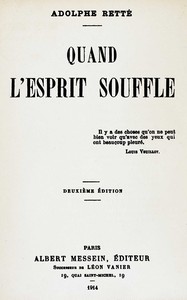
Quand l'esprit souffle by Adolphe Retté
Adolphe Retté's Quand l'esprit souffle is a short, autobiographical novel that feels less like a story and more like a confession. Originally published in 1897, it documents a very specific and turbulent period in the young author's life.
The Story
The book follows Adolphe, a stand-in for the author himself. He's a poet and writer in fin-de-siècle Paris, immersed in the city's artistic and sometimes anarchist circles. He has firmly rejected the Catholicism of his upbringing, viewing it as empty ritual. The first part of the book shows us a man adrift, intellectually proud but spiritually numb. He visits famous churches like Notre-Dame and feels absolutely nothing but cold stone.
Then, the pivot. Without warning, during a walk, he is struck by an experience so powerful it shatters his worldview. He describes it as a direct, personal encounter with the divine—a moment of pure grace that bypasses his intellect completely. The rest of the book charts the chaotic aftermath: his frantic return to the Church, the confusion of his radical friends who think he's lost his mind, and his own shaky attempts to reconcile this emotional earthquake with his rational mind.
Why You Should Read It
What makes this book special isn't the theology, but the psychology. Retté is brutally honest about his pride before the experience and his bewilderment after. He doesn't try to make himself look good. He shows us his arrogance, his fear, and his desperate need to make sense of something that defies sense. You're not reading a polished argument for conversion; you're reading the messy, real-time journal of a man whose foundation has been ripped out from under him.
It’s this raw vulnerability that connects across 130 years. Whether you're religious, spiritual, or skeptical, the core human experience here is recognizable: that moment when life forces you to question everything you thought you knew about yourself. The writing is intense and poetic, pulling you right into his inner turmoil.
Final Verdict
This book is perfect for readers who love personal, introspective journeys over action-packed plots. If you're interested in late 19th-century French thought, spiritual memoirs, or just compelling accounts of personal crisis and transformation, give it a try. It's also a great, accessible entry point to the literature of that era. Fair warning: it's a dense, emotional shot of espresso, not a leisurely latte. You won't get neat answers, but you will get a fascinating, unforgettable look into one man's struggle with the biggest questions of all.
Joshua Sanchez
1 year agoAmazing book.
Joshua Taylor
1 year agoGreat digital experience compared to other versions.
Lucas Williams
1 year agoHonestly, the arguments are well-supported by credible references. I would gladly recommend this title.
Emma Davis
5 months agoHigh quality edition, very readable.



Michael Anderson
2 years agoClear and concise.