1

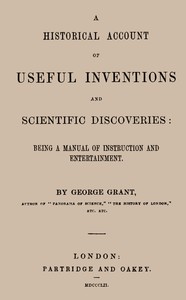
A Historical Account of Useful Inventions and Scientific Discoveries Being a manual of instruction and entertainment. — Inside the Classic
(0 User reviews)
212
Project Gutenberg
2016
Not confirmed
Inventions -- History
Readers of public-domain and historical texts
Project Gutenberg digital edition
en
Edition facts
Words
81,113
Reading time
353 min
Text sections
39
This digital edition of A Historical Account of Useful Inventions and Scientific Discoveries Being a manual of instruction and entertainment. — Inside the Classic is described by source-level measurements including 81,113 words, 5 hr 53 min estimated reading time, and 39 detected text sections.
The text analysis averages about 30.8 words per sentence, while the detected sections provide another way to judge how the source is divided.
Project Gutenberg metadata also associates the work with “Inventions -- History,” connecting these edition facts with the source record’s subject description.
Source:
Project Gutenberg record #53613
George Grant's 19th-century compendium traces the history of inventions and scientific discoveries, using a chronological structure that moves from ancient astronomy to modern mechanics, with recurring emphasis on the practical and moral dimensions of innovation.
Read the complete public-domain text at its original source.
Read on Project GutenbergGeorge Grant's A Historical Account of Useful Inventions and Scientific Discoveries opens not with a preface but with a publisher's list of contemporary books, situating the work within a mid-19th-century market for instructive and morally uplifting literature. The volume then proceeds through a series of chapters that trace technological and scientific progress from antiquity to the modern era, with a particular focus on astronomy, navigation, and mechanical arts. Grant's method is cumulative: each invention or discovery is presented as a step in a chain of human ingenuity, often linked to the practical needs of commerce and daily life.
Chronological Structure and the Progress Narrative
The book is organized chronologically, beginning with ancient astronomers like Hipparchus and moving through the Middle Ages to the Renaissance and beyond. Grant treats each era as a stage in a linear progression of knowledge, emphasizing how earlier discoveries enabled later ones. For instance, he notes that Hipparchus's star catalogues and parallax methods laid groundwork for later geography and astronomy. This structure reinforces a narrative of steady improvement, though Grant occasionally acknowledges setbacks, such as the decline after the Roman Empire. The chronological framework gives the work a sense of purpose, as each chapter builds on the last, though the excerpts do not reveal whether Grant maintains this structure consistently throughout the entire book.
Recurring Images of Light and Vision
Throughout the excerpts, Grant repeatedly invokes imagery of light, sight, and celestial observation. Hipparchus's work is described in terms of marking stars, constructing spheres, and reducing appearances to a central point. The language of vision—'observing,' 'viewed,' 'appeared'—permeates the account, suggesting that knowledge itself is a form of seeing clearly. This motif extends to later sections, where inventions like the telescope or the printing press might be framed as tools that extend human sight. The emphasis on visual clarity aligns with the book's stated aim of providing 'instruction and entertainment,' as if the reader is being invited to see the world more distinctly through the lens of history.
Movement Between the Local and the Universal
Grant's narrative frequently shifts between specific, localized details and broad, universal principles. For example, he describes Hipparchus's observation of a tree in a plain to explain parallax, then immediately applies this to the movement of stars across the entire globe. This technique of grounding abstract concepts in concrete, everyday experiences recurs throughout the excerpts. Similarly, the book moves from the work of individual inventors—like Sacrobosco, 'a native of Halifax, in Yorkshire'—to the global implications of their discoveries. This oscillation between the particular and the general helps make complex ideas accessible, while also suggesting that innovation is both a personal and a collective endeavor.
The Moral and Practical Underpinnings of Invention
Grant consistently frames inventions and discoveries as serving practical human needs, often with an implicit moral dimension. The publisher's list at the front includes titles like Self-Reliance; a Book for Young Men, hinting at the era's values of perseverance and industry. In the text, Grant praises Hipparchus for his 'labour' and notes that his star catalogue was undertaken for 'the benefit of future observers.' This language suggests that invention is not merely intellectual but also virtuous—a contribution to the common good. The book's structure, moving from ancient to modern, reinforces the idea that each generation builds on the moral and practical foundations laid by its predecessors, though the excerpts do not reveal whether Grant explicitly moralizes in later chapters.
Readers approaching Grant's work should expect a narrative that values clarity and cumulative progress, with each invention presented as a link in a chain of human achievement. The book's strength lies in its concrete examples and its ability to move from the specific to the general, though its 19th-century perspective means that some claims may reflect the limitations of contemporary knowledge. For those interested in how earlier generations understood the history of technology, this account offers a revealing window into the values and assumptions of its time.
That rainy afternoon, George Grant’s careful chronicle made me feel the patient weight of every forgotten mechanism, each invention a quiet answer to a particular human need. It left me wondering what answers our own era expects. Somehow, I found myself reaching for Twentieth Century Inventions: A Forecast — A Closer Reading, which felt less like a sequel and more like a whispered continuation of that same hopeful, uncertain conversation.
There are no reviews for this eBook.
There are no comments for this eBook.
Reader reflection
Take a moment to reflect on this book
Create a short personal record of your experience with this book.
Your progress
0
/
10
2
Did this book hold your interest?
3
Would you encourage someone else to read it?
4
How demanding did the text feel?
5
How did the reading compare with what you expected?
6
How strong was your personal connection to the text?
7
Which aspect of the book did you value most?
8
Was the book easy to understand?
9
What is the main idea you are taking away?
10