1

Discoveries and Inventions of the Nineteenth Century — Background and Themes
(0 User reviews)
58
Project Gutenberg
2017
Not confirmed
Inventions -- History -- 19th century
Readers of public-domain and historical texts
Project Gutenberg digital edition
en
Edition facts
Words
386,757
Reading time
1682 min
Text sections
71
The source record for Discoveries and Inventions of the Nineteenth Century — Background and Themes measures this digital text at 386,757 words, 28 hr 2 min estimated reading time, and 71 detected text sections.
The text analysis averages about 27.0 words per sentence, while the detected sections provide another way to judge how the source is divided.
Project Gutenberg metadata also associates the work with “Inventions -- History -- 19th century,” connecting these edition facts with the source record’s subject description.
Source:
Project Gutenberg record #54475
Robert Routledge's 1900 survey of 19th-century inventions, from steam engines to spectroscopy, organized by technical domain with detailed illustrations and a preface emphasizing the century's unprecedented material and intellectual progress.
Read the complete public-domain text at its original source.
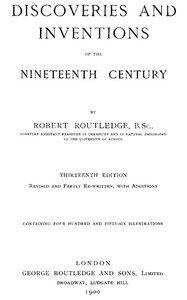
Read on Project GutenbergRobert Routledge opens his survey with an epigraph from Emerson that frames the nineteenth century as an age where 'wit draws the threads of fair and fit' from raw materials—a theme he immediately reinforces in his preface. He argues that the period's discoveries and inventions 'distinguish it not merely in comparison with any previous century, but in comparison with all the centuries that have preceded,' citing railways, steam navigation, and the telegraph as transformative forces. The preface also notes that the thirteenth edition (1900) required a complete rewrite of the article on iron and steel, signaling how rapidly the field evolved even as the book was being updated.
A Century of Material and Intellectual Change
Routledge's preface establishes a dual focus: the 'far-reaching intellectual acquisitions' and the 'material achievements' that together 'profoundly affected our ways of thinking and our habits of life.' He singles out the steam engine as the foundational invention, though it 'properly assignable to a period preceding our era by a few years.' This careful dating reflects the book's historical rigor. The preface also hints at the book's structure: each chapter treats a specific technology or scientific field, from iron manufacture to telegraphy, with the steam engine placed first because of its enabling role. Readers should note that Routledge does not claim to cover every invention; he acknowledges that 'selection was of course necessary' from a vast field.
Spectroscopy: Precision and Technical Detail
In the excerpt on spectroscopy, Routledge demonstrates his characteristic method: he explains apparatus, procedure, and results with concrete numbers. He describes how 'characteristic bright lines' appear when sparks pass between metal pieces, and notes that the spectrum of iron yields 'no fewer than 450 lines.' The text includes a detailed account of Mr. Browning's 'neat little apparatus' for spark spectra, which uses a compact condenser inside a box. Routledge also explains the challenges of studying non-metallic elements: silicon and carbon resist volatilization, and carbon's spectrum varies with the compound, so 'no definite spectrum can be assigned to the element.' This passage shows the book's blend of practical instruction and scientific caution.
Illustrations as Integral Evidence
The book contains 456 illustrations, and the excerpt references 'Fig. 223' and 'Plate XVII.' The illustrations are not decorative but functional: Fig. 223 depicts the apparatus for spark spectra, while Plate XVII shows spectra of hydrogen and nitrogen. Routledge often directs the reader to these figures mid-sentence, as when he writes 'Nos. 12 and 13, in Plate XVII., are the spectra of hydrogen and of nitrogen respectively.' The illustrations thus serve as primary evidence, allowing readers to see the spectral lines or mechanical designs described. This integration of text and image is a hallmark of the work, making complex technical descriptions more accessible.
The Spectroscope as a Unifying Instrument
Routledge uses the spectroscope to connect multiple fields: chemistry, physics, and astronomy. He explains that the same spectral lines appear whether a metal is volatilized in a flame or sparked electrically, and that the spark spectrum reveals additional lines. He also describes how Geissler tubes—rarefied gas tubes—produce light that, when examined by the spectroscope, yields 'bright lines, characteristic of each gas.' This technique allowed scientists to identify elements in distant stars. The excerpt thus illustrates how a single instrument could unify disparate areas of inquiry, a theme that runs through the book. Readers should watch for similar cross-disciplinary connections in other chapters.
Routledge's book rewards readers who engage with its illustrations and technical descriptions. The preface sets clear expectations: this is a selective survey, not an encyclopedia, and each chapter builds on the steam engine's legacy. The spectroscopy excerpt exemplifies the book's strengths—precision, historical context, and a willingness to acknowledge scientific limits. For a first reading, focus on how Routledge balances popular accessibility with technical accuracy, and note how the illustrations function as evidence rather than decoration.
That rain fell in sheets against the window while Routledge’s engravings of dynamos blurred into grey, yet his preface lingered—the sheer astonishment that one century could hold so much. Later, shelving books, my hand paused on a slimmer volume, almost accidentally. It felt like finding the same warm astonishment, gently re-told. The Story of Great Inventions — A Reader’s Guide sat there, quiet, patient, as if waiting for the rain to stop.
There are no reviews for this eBook.
There are no comments for this eBook.
Reader reflection
What was your reading experience?
Capture what you thought, learned, and would like to remember.
Your progress
0
/
10
2
Did this book hold your interest?
3
Would you pass this book on to a friend?
4
How easy was the book to follow?
5
Was the book what you thought it would be?
6
Was the book easy to understand?
7
How useful were the ideas in this book?
8
Did any part of the book feel personally relevant?
9
In one sentence, what did you learn?
10