1

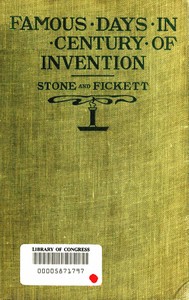
Famous Days in the Century of Invention — A Closer Reading
(0 User reviews)
1523
Project Gutenberg
2014
Not confirmed
Inventions
Readers of public-domain and historical texts
Project Gutenberg digital edition
en
Edition facts
Words
33,122
Reading time
145 min
Text sections
5
Famous Days in the Century of Invention — A Closer Reading can be approached with a clearer sense of reading commitment from its source measurements: 33,122 words, 2 hr 25 min estimated reading time, and 5 detected text sections.
The text analysis averages about 17.1 words per sentence, while the detected sections provide another way to judge how the source is divided.
Project Gutenberg metadata also associates the work with “Inventions,” connecting these edition facts with the source record’s subject description.
Source:
Project Gutenberg record #46150
This editorial note examines how Stone and Fickett use a child's perspective and conversational framing to narrate 19th-century inventions, focusing on shifts in narrative pace and voice across the sewing machine, rubber, and electric car chapters.
Read the complete public-domain text at its original source.
Read on Project GutenbergStone and Fickett open their account of the sewing machine not with the inventor but with a boy named Jonathan Wheeler, who wakes at half past three on a June morning in 1845, excited by the prospect of his first railway ride. The narrative voice immediately establishes a child’s sensory world—robins chattering, a red glow through the window, the hurry into best clothes. This perspective, sustained across several chapters, creates a deliberate contrast between the domestic, experiential frame and the technical subject matter. The authors embed inventions within the rhythms of family travel, conversation, and waiting, so that the pace of the prose mirrors the slow, anticipatory tempo of nineteenth-century life before the very innovations being described accelerated it.
Narrative Framing Through a Child’s Eyes
The excerpts consistently filter complex technological history through young characters. Jonathan Wheeler’s journey to Boston in the sewing machine chapter is described in terms of what a child notices: the blue wagon, the eight siblings left behind, the promise of store clothes. Later, Lucy attends the Goodyear patent trial and identifies the inventor by his rubber cap and vest, a detail supplied by her grandfather’s wry description. This framing device does more than simplify; it establishes a pace of discovery. The reader learns alongside the child, encountering technical explanations only after the human scene is set. The voice remains colloquial and immediate—“It is! It is!” chattered the robins—even when the subject shifts to patent law or the chemistry of rubber. The effect is to domesticate invention, making the unfamiliar familiar through a child’s limited but eager understanding.
Shifts in Pace Between Domestic and Legal Scenes
The book’s pacing varies markedly between its two predominant settings: the home and the courtroom. In the sewing machine chapter, time moves slowly, measured by the fifteen-mile wagon ride to the station and the wait for the afternoon train. Sentences are longer, filled with circumstantial detail about the Fitchburg railroad’s terminal at Charlestown and the stagecoach to Brattle Street. By contrast, the Goodyear chapter accelerates once Lucy enters the court. The formalities are “quickly over,” and Daniel Webster’s speech—though long—is compressed into a few paragraphs. The narrative voice shifts from descriptive to expository, summarizing Webster’s argument rather than rendering it moment by moment. This change in pace reflects the shift from experiential learning (the child’s journey) to informational summary (the legal outcome). The authors seem to trust that the courtroom drama needs less staging than the domestic scene.
Voice and the Use of Embedded Dialogue
Stone and Fickett rely heavily on embedded dialogue and reported speech to advance their narrative without abandoning the child’s perspective. In the sewing machine chapter, Jonathan’s thoughts are rendered as direct interior monologue: “Is it really pleasant?” In the Goodyear chapter, Lucy’s grandfather supplies the memorable description of the inventor’s rubber attire, and Lucy herself asks excitedly, “Is that Mr. Goodyear?” The authors also incorporate Webster’s courtroom declaration—“Whatever may be Mr. Goodyear’s claims”—as a block quotation, shifting the voice from the child’s to the orator’s. This technique creates a layered texture: the reader hears the child’s wonder, the adult’s explanation, and the historical figure’s rhetoric within a single scene. The voice never settles into a single register, which keeps the prose lively but occasionally risks abrupt transitions between informal and formal tones.
Readers attentive to narrative craft will notice how Stone and Fickett use pacing as a pedagogical tool: slow, sensory scenes for new concepts; compressed summaries for familiar outcomes. The child protagonists serve as stand-ins for the reader, their questions and observations guiding the exposition. This method works best when the authors resist the urge to lecture and instead let the scene carry the information, as in the opening robin chorus. The book rewards a reading that pays attention to who is speaking and how fast the story moves, rather than treating the inventions as the sole focus.
The rain drummed on the windowsill while I traced the sewing machine’s chapter, noting how Stone and Fickett slowed time for a child’s wonder. That unhurried rhythm felt familiar. Later, flipping pages, I stumbled onto Records of a Family of Engineers — Context and Discussion, and the quiet patience of those coastal engineers seemed to answer something the inventors had left unsaid. Famous Days stayed open beside it all afternoon.
There are no reviews for this eBook.
There are no comments for this eBook.
Reader reflection
What did you think of this book?
Answer a few questions and save a private reflection on this device.
Your progress
0
/
10
2
Was reading this book enjoyable?
3
Is this a title you would suggest to others?
4
How demanding did the text feel?
5
Was the book easy to understand?
6
How well did it match your expectations?
7
Did it raise ideas you would like to talk about?
8
Did you gain anything practical from the text?
9
What did this book teach you most?
10