1

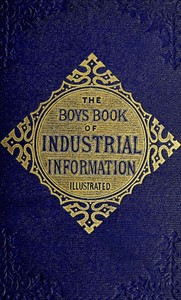
The Boy's Book of Industrial Information — Context and Discussion
(0 User reviews)
886
Project Gutenberg
2015
Not confirmed
Technology -- Juvenile literature; Industrial arts -- Juvenile literature
Readers of public-domain and historical texts
Project Gutenberg digital edition
en
Edition facts
Words
76,935
Reading time
335 min
Text sections
12
The catalog record for The Boy's Book of Industrial Information — Context and Discussion provides practical reading context through 76,935 words, 5 hr 35 min estimated reading time, and 12 detected text sections.
The text analysis averages about 36.8 words per sentence, while the detected sections provide another way to judge how the source is divided.
Project Gutenberg metadata also associates the work with “Technology -- Juvenile literature,” connecting these edition facts with the source record’s subject description.
Source:
Project Gutenberg record #49489
Elisha Noyce's 1858 guide uses plain, instructive prose to explain industrial processes like stained glass and cotton manufacture, with detailed descriptions of machinery and materials.
Read the complete public-domain text at its original source.
Read on Project GutenbergElisha Noyce's The Boy's Book of Industrial Information (1858) opens with a preface that sets a clear, instructive tone: the author aims to supply “a clear and brief description of the materials, processes, and apparatus” of industry. The voice is direct and purposeful, avoiding florid language in favor of practical explanation. Noyce emphasizes that every article and process “can be made to have a value and an interest” proportionate to the reader's knowledge. This utilitarian ethos shapes the entire work, which proceeds methodically through topics such as glass-making and cotton manufacture.
A Voice of Patient Instruction
Noyce's narrative voice is consistently patient and explanatory, as seen in his description of stained glass. He carefully distinguishes “stained glass” from “glass-painting,” noting that colors in stained glass “are formed in the substance of the glass itself.” The prose moves step by step: the artist makes a design, then full-sized cartoons, then the glazier cuts glass pieces “with his diamond.” The process is likened to “a child's puzzle,” a simile that makes the complex accessible. The tone remains even, never rushed, and the author frequently uses phrases like “the next course is” to guide the reader. This steady, pedagogical rhythm is a hallmark of the book's style.
Pace and Detail in Industrial Descriptions
The pacing varies with the complexity of the subject. In the cotton manufacture section, the description accelerates through a sequence of machines: the “combing machine,” the “willow,” the “scotching” or “blowing machine,” then the “carding machine.” Each is given a brief function—the carding machine “consists of cylinders having fine wires projecting from their surfaces acting in different directions.” The sentences are shorter, and the rhythm mimics the mechanical progression. In contrast, the stained glass passage lingers on the painter's role, explaining that his task is “not to produce the colors, but by his brown shadowing to bring out the design.” This shift in pace reflects the author's judgment of what merits closer attention.
Recurring Structural Patterns
Noyce frequently uses a pattern of definition, process, and purpose. For example, in the stained glass section, he first defines the term, then outlines the steps (design, cutting, painting, firing), and finally explains the purpose of each step. The same structure appears in the cotton section: after sorting, the cotton is “dressed by the ‘combing machine,’” then “scotched,” then carded—each step defined and its function stated. This repetition creates a predictable, easy-to-follow framework. The author also uses parenthetical explanations, such as “called a ‘willow,’ as it was originally a sort of basket,” to clarify terminology without breaking the narrative flow.
Readers will find that Noyce's methodical approach rewards careful attention. The book's value lies not in narrative drama but in the clarity with which it renders invisible processes visible. Pay particular attention to the author's use of analogy and his habit of defining terms in context—these are the tools that make the industrial world intelligible. The 365 engravings by the Brothers Dalziel, mentioned in the preface, complement the text and are worth consulting as you read.
I think of The Boy's Book of Industrial Information often—how its plain prose taught me that glass and cotton both begin as humble grit. Years later, I found a quieter companion in Triumphs of Invention and Discovery in Art and Science — Edition Insights, where those same labours glow with wonder. They share a patient breath, like two old friends recounting the same hard day.
There are no reviews for this eBook.
There are no comments for this eBook.
Reader reflection
Take a moment to reflect on this book
Create a short personal record of your experience with this book.
Your progress
0
/
10
2
How did the book work for you overall?
3
Would you pass this book on to a friend?
4
What was the reading difficulty like?
5
What was its emotional impact?
6
How useful were the ideas in this book?
7
How strong was your personal connection to the text?
8
How would you describe its reading pace?
9
What did this book teach you most?
10