1

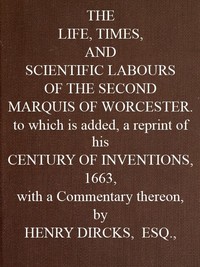
The Life, Times, and Scientific Labours of the Second Marquis of Worcester To which is added a reprint of his Century of Inventions, 1663, with a Commentary thereon. — Inside the Classic
(0 User reviews)
97
Project Gutenberg
2016
Not confirmed
Industrial arts -- History; Inventions; Worcester, Edward Somerset, Marquis of, 1601-1667
Readers of public-domain and historical texts
Project Gutenberg digital edition
en
Edition facts
Words
188,529
Reading time
820 min
Text sections
30
For The Life, Times, and Scientific Labours of the Second Marquis of Worcester To which is added a reprint of his Century of Inventions, 1663, with a Commentary thereon. — Inside the Classic, the stored edition analysis reports 188,529 words, 13 hr 40 min estimated reading time, and 30 detected text sections.
The text analysis averages about 26.3 words per sentence, while the detected sections provide another way to judge how the source is divided.
Project Gutenberg metadata also associates the work with “Industrial arts -- History,” connecting these edition facts with the source record’s subject description.
Source:
Project Gutenberg record #51903
Henry Dircks's 1865 biography of Edward Somerset, second Marquis of Worcester, combines a detailed life narrative with a reprint of 'Century of Inventions' (1663) and commentary. The work examines the Marquis's mechanical ingenuity, particularly his water-commanding engine, and his political role during the English Civil War, drawing on original documents and correspondence.
Read the complete public-domain text at its original source.
Read on Project GutenbergHenry Dircks, a civil engineer, opens his biography of Edward Somerset, second Marquis of Worcester, by placing him among 'the most eminent scientific celebrities of Europe' and claiming that his 'original genius' in mechanical invention rivals that of Archimedes. The work is structured as both a life narrative and a technical commentary, culminating in a reprint of the Marquis's 1663 Century of Inventions. Dircks draws on original documents, including letters and petitions, to reconstruct the Marquis's activities as a Royalist officer, inventor, and projector. The biography is notable for its detailed attention to the political and economic context of the Marquis's projects, such as his 'Water-commanding Engine,' which Dircks argues was a precursor to the modern steam engine.
A Life in Documents
Dircks relies heavily on primary sources, quoting extensively from the Marquis's own writings and contemporary records. For instance, the Marquis's proposal to raise a troop of horse for Charles I is presented in full, revealing his rhetorical skill and self-deprecating tone: 'I shall with more joy and readiness serve as a trooper therein, than to have the command thereof.' Similarly, his offer to fund a charity for 'indigent officers' from the profits of his engine shows how he intertwined mechanical invention with social obligation. Dircks does not simply narrate events; he lets the documents speak, often with minimal editorial intervention. This method gives readers direct access to the Marquis's voice, but it also means that the biography sometimes reads as a compilation of evidence rather than a synthesized narrative. The excerpts suggest that Dircks prioritizes authenticity over readability, a choice that will appeal to researchers but may challenge casual readers.
The Engine and Its Promises
The 'Water-commanding Engine' is the centerpiece of the Marquis's inventive career, and Dircks treats it with the attention of a fellow engineer. He describes it as 'that Titanic power' that eventually led to the modern steam engine, though the excerpts do not reveal its precise mechanism. The Marquis's own descriptions, as quoted by Dircks, focus on the engine's potential benefits: he offers to use its profits to build a causeway 'for 2 miles together' at four London avenues, and to endow a reading program for veterans. These proposals blend technical ambition with civic philanthropy, but they also hint at the gap between promise and realization. Dircks does not explicitly state whether the engine was successfully built or operated at scale; instead, he presents the Marquis's plans as evidence of his inventive vision. Readers interested in the history of technology will find Dircks's commentary valuable, but they should note that the excerpts provide more detail about the Marquis's promotional efforts than about the engine's engineering principles.
The Century of Inventions: A Reprint with Commentary
The second half of the book reprints the Marquis's 1663 Century of Inventions, a list of one hundred mechanical devices, many of which were never built. Dircks adds a commentary that attempts to identify which inventions were original and which anticipated later developments. The excerpts do not include the full list, but the title page indicates that Dircks's edition is a 'reprint ... with a Commentary thereon.' This structure makes the book a hybrid: part biography, part primary source, part technical analysis. Dircks's perspective as a civil engineer is evident in his focus on practical feasibility and historical priority. However, the excerpts do not reveal his criteria for evaluating the inventions, nor do they show whether he verified any of the Marquis's claims. Readers should approach the commentary as a nineteenth-century engineer's interpretation, not as a definitive technical assessment. The reprint itself is a valuable resource for those studying early modern invention, but it requires careful reading to distinguish the Marquis's original text from Dircks's annotations.
Dircks's biography is best approached as a documentary history rather than a polished narrative. Readers will benefit from familiarity with seventeenth-century English politics and the early history of steam power. The book's strength lies in its preservation of primary sources, including the Marquis's own proposals and the full text of the Century of Inventions. Those seeking a concise life story may find the digressions into technical commentary and political context challenging, but for researchers interested in the intersection of invention, patronage, and civil war, this work offers a rich, if dense, resource.
Reading about the Marquis’s water-commanding engine, I felt that peculiar loneliness of a mind working ahead of its era. It reminded me of the quiet patience in Records of a Family of Engineers — Context and Discussion, where generations of men also wrestled with the sea and machinery, almost privately. There is something tender about such solitary persistence, whether in a seventeenth-century court or a Victorian household. I lingered on that thought for a while.
There are no reviews for this eBook.
There are no comments for this eBook.
Reader reflection
What was your reading experience?
Capture what you thought, learned, and would like to remember.
Your progress
0
/
10
2
How did the book work for you overall?
3
Would you recommend this book to another reader?
4
How much effort did this book require?
5
Did the book deliver what you hoped for?
6
How personally connected did you feel to the book?
7
Was the book moving at the right speed?
8
How valuable was this book for your own interests?
9
What is the main idea you are taking away?
10