1

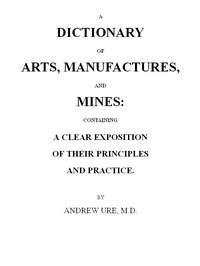
A Dictionary of Arts, Manufactures and Mines containing a clear exposition of their principles and practice — A Closer Reading
(0 User reviews)
41
Project Gutenberg
2014
Not confirmed
Industrial arts -- Dictionaries; Technology -- Dictionaries
Readers of public-domain and historical texts
Project Gutenberg digital edition
en
Edition facts
Words
1,075,417
Reading time
4676 min
Text sections
157
A Dictionary of Arts, Manufactures and Mines containing a clear exposition of their principles and practice — A Closer Reading can be approached with a clearer sense of reading commitment from its source measurements: 1,075,417 words, 77 hr 56 min estimated reading time, and 157 detected text sections.
The text analysis averages about 24.2 words per sentence, while the detected sections provide another way to judge how the source is divided.
Project Gutenberg metadata also associates the work with “Industrial arts -- Dictionaries,” connecting these edition facts with the source record’s subject description.
Source:
Project Gutenberg record #44562
Andrew Ure's 1840 dictionary systematically explains the principles and practices of 19th-century industrial arts, from mining to manufacturing, with precise technical descriptions and engravings. The preface defines manufacture as a species of industry effecting change in substances for the general market, while entries like 'Indigo' detail cultivation, extraction, and geographic variation.
Read the complete public-domain text at its original source.
Read on Project GutenbergAndrew Ure opens his 1840 dictionary with a clear taxonomy of industry: primary production falls to husbandman, fisherman, and miner; transformation to manufacturer and artisan; distribution to engineer, shipwright, and sailor. He distinguishes his work from Loudon's agricultural encyclopedias and M'Culloch's commercial dictionary, positioning it as a guide to the mechanical and chemical transformations that turn raw materials into exchangeable goods. The entry on indigo exemplifies this approach, tracing the plant from Bengal to America, describing fermentation vats and beating vats, and noting that bright sunshine is most advantageous to pigment production.
A System of Industrial Classification
Ure's preface establishes a hierarchical division of labour that frames the entire dictionary. He assigns the engineer to motive power and transport, the handicraftsman to local modifications, and his own subject—arts and manufactures—to the middle ground of transforming materials for the general market. Iron serves as his example: the engineer sinks shafts and erects pumps, while the manufacturer converts ore into marketable metal. This classification is not merely taxonomic; it reflects a belief that industrial progress depends on clearly defined roles. The dictionary thus becomes a tool for understanding how each trade fits into a larger economic machine, with Ure acting as the interpreter of principles behind practice.
The Geography of a Dye: Indigo in Detail
The indigo entry reveals Ure's method: combine botanical taxonomy, geographic specificity, and process description. He lists species—Indigofera tinctoria, disperma, Anil, Argentea, Pseudotinctoria, Glauca—and maps them to regions: Bengal, Malabar, Madagascar, the West Indies, Africa, Egypt. He notes that Kishenagar, Jessore, and Moorshedabad produce the finest indigo, while Burdwan and Benares yield coarser grain. The extraction process is described in two methods: fermentation of fresh leaves and maceration of dried leaves. In Bengal factories, stone-built cisterns—a fermenting vat 20 feet square and 3 feet deep, and a longer beating vat—are used. The plant is stratified, weighted with beams and bamboo, and pumped with water. Such detail transforms a dictionary entry into a field manual.
Evidence of Maturity and the Limits of Inference
Ure reports that indigo plants are ready to cut when flower buds burst forth and blossoms expand, or when leaves break across when doubled flat. Yet he adds a caution: this leaf test is 'somewhat fallacious, and depends upon the poverty or richness of the soil.' He also notes that heavy rain causes plants to grow too rapidly and fail to elaborate blue pigment. These observations show Ure's willingness to qualify his sources, acknowledging that practical indicators are not absolute. From the excerpts alone, we cannot know whether the dictionary consistently applies such critical scrutiny, but the indigo entry suggests a mind attentive to the gap between rule and reality in manufacturing processes.
Readers approaching this dictionary should treat it as a snapshot of industrial knowledge at a moment when chemistry and mechanics were reshaping production. Ure's voice is that of a systematizer, not a storyteller; his entries reward those who read for process rather than plot. The engravings mentioned in the title are absent from the text excerpts, but the verbal descriptions often compensate with precise dimensions and sequences. For anyone curious about how 19th-century manufacturers understood their own trades, this work offers a rare, unadorned view.
The rain kept me indoors with Ure’s dictionary, turning pages on indigo vats and steam hammers. There, between the engravings, I found a quiet wonder at human ingenuity. That afternoon drifted toward another shelf, where I pulled down Great Facts A Popular History and Description of the Most Remarkable Inventions During the Present Century — Story, Setting & Ideas, and the rain seemed to slow around those familiar marvels, retold with a softer light.
There are no reviews for this eBook.
There are no comments for this eBook.
Reader reflection
Record your reading impressions
A brief reflection can help important ideas stay with you longer.
Your progress
0
/
10
2
How much did you enjoy the reading experience?
3
Is this a title you would suggest to others?
4
How easy was the book to follow?
5
Which element worked best for you?
6
Did the book give you something worth debating?
7
What did you think about the pace?
8
How original did the book feel?
9
What did this book teach you most?
10