1

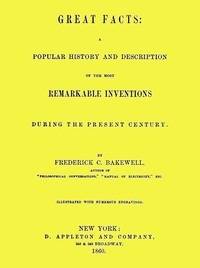
Great Facts A Popular History and Description of the Most Remarkable Inventions During the Present Century — Story, Setting & Ideas
(0 User reviews)
992
Project Gutenberg
2014
Not confirmed
Inventions
Readers of public-domain and historical texts
Project Gutenberg digital edition
en
Edition facts
Words
77,927
Reading time
339 min
Text sections
9
For Great Facts A Popular History and Description of the Most Remarkable Inventions During the Present Century — Story, Setting & Ideas, the stored edition analysis reports 77,927 words, 5 hr 39 min estimated reading time, and 9 detected text sections.
The text analysis averages about 28.7 words per sentence, while the detected sections provide another way to judge how the source is divided.
Project Gutenberg metadata also associates the work with “Inventions,” connecting these edition facts with the source record’s subject description.
Source:
Project Gutenberg record #45124
Frederick C. Bakewell's 1860 survey of 19th-century inventions, from steam navigation to the Atlantic telegraph, explains mechanisms without technical jargon. The excerpts show a focus on practical engineering challenges, such as cable insulation and the Leyden jar effect, rather than biographical or social context.
Read the complete public-domain text at its original source.
Read on Project GutenbergFrederick C. Bakewell's Great Facts (1860) opens with a preface that frames the book as a practical guide for youth and general readers, aiming to explain the 'origin and progress' of inventions like steam navigation, railways, the electric telegraph, and photography. The author explicitly avoids detailed technical treatises, promising instead a 'succinct, intelligible account, free from technicalities.' This editorial note examines how the catalog subject 'Inventions' aligns with the actual content of the excerpts, which reveal a strong emphasis on mechanical description and engineering problem-solving rather than historical narrative or social impact.
Engineering Detail Over Historical Narrative
The excerpts from Great Facts devote considerable space to the physical construction of submarine telegraph cables. Bakewell describes the five-wire cable enclosed in a hollow iron wire cable, with each wire 'first slightly twisted, to prevent them from being broken when stretched.' He then details the protective layers: hempen yarn to guard the gutta percha, and the outer iron wire casing. This level of mechanical specificity—including a woodcut reference—is typical of the work. The catalog subject 'Inventions' is accurate, but the book's focus is less on the inventors' biographies or the social consequences of inventions and more on how things are built and why they work. Bakewell's explanation of the Leyden jar effect in buried wires is another example: he notes that a wire coated with gutta percha and surrounded by moist earth 'becomes an elongated Leyden jar,' a phenomenon he says 'could scarcely have been anticipated.' Such passages reveal a work grounded in practical physics and engineering challenges.
The Atlantic Cable as a Case Study in Problem-Solving
Bakewell uses the Atlantic telegraph cable to illustrate the iterative nature of invention. He contrasts the heavy, expensive cables used for shorter routes—like the Dover-to-Ostend line—with the 'frail cable' attempted for transatlantic communication. The Atlantic cable's conductor consisted of 'seven strands of fine copper wire twisted together,' with an aggregate thickness no greater than a single copper wire in other cables. Bakewell notes that the cable's successful laying, after many failures, proved that 'telegraphic communication with America is a practicable undertaking,' even though communication through that cable had ceased. This measured optimism is characteristic of the book's tone: it celebrates progress without overpromising. The catalog subject 'Inventions' is thus realized through concrete examples of trial and error, not through a triumphalist narrative. Bakewell's treatment of the cable's insulation and the 'excellent insulation obtained by means of gutta percha covered wires' shows his interest in the material science behind invention.
Audience and Accessibility in the Preface
The preface to Great Facts explicitly addresses its intended readership: 'the inquiring youth' and those who want to know 'by what means such wonders as Steam Navigation, Locomotion on Railways, the Electric Telegraph, and Photography have been gradually developed.' Bakewell argues that understanding the 'successive steps' of invention teaches 'a useful lesson of perseverance under difficulties' and impresses 'many valuable scientific truths.' This pedagogical aim shapes the book's structure and content. The catalog subject 'Inventions' is therefore filtered through a lens of popular education. Bakewell contrasts his work with Beckman's earlier History of Inventions, implying that his own book covers more recent developments. The preface also reveals a tension: Bakewell wants to avoid technical jargon, yet the excerpts show he does not shy away from detailed descriptions of cable construction or electrical phenomena. This suggests that 'popular' for Bakewell meant accessible to a literate audience willing to engage with mechanical diagrams and scientific principles, not a simplified or anecdotal account.
Readers approaching Great Facts should expect a work that prioritizes the 'how' over the 'who' or 'why' of invention. Bakewell's prose is direct and descriptive, often relying on visual aids like woodcuts to convey mechanical structures. The book is best read as a snapshot of mid-19th-century engineering knowledge, where the challenges of submarine telegraphy and railway locomotion were still fresh. Those interested in the social or economic impact of these inventions will need to look elsewhere; this volume stays close to the machines themselves.
I kept thinking about how Bakewell made the telegraph feel like a quiet miracle of patience, not spectacle. It lingered the way a good workshop does. That same unhurried curiosity found me again in A Dictionary of Arts, Manufactures and Mines containing a clear exposition of their principles and practice — A Closer Reading, where even simple processes open into deep, steady wonder.
There are no reviews for this eBook.
There are no comments for this eBook.
Reader reflection
How did this book work for you?
Your answers remain private and are stored only in this browser.
Your progress
0
/
10
2
Did this book hold your interest?
3
Would you recommend this book to another reader?
4
Did the language feel accessible?
5
Was the book easy to understand?
6
How distinctive were its ideas or approach?
7
How useful did the reading feel?
8
How personally connected did you feel to the book?
9
What did this book teach you most?
10