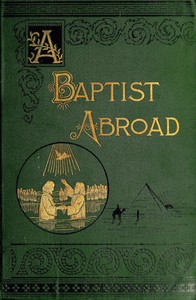
was much flattered by a request from Humboldt to call and see him. The _savant_ soon showed that from reading and inquiry he had more knowledge of the city than the youth had acquired by his visit. With some mortification and a little petulance the young man said: “I understood, sir, that you had never visited the Holy City.” “True,” replied Humboldt, “I never have; but I once got ready to go.” Mr. Whittle, with wise forethought, had made preparation for his visit. He knew what he wanted to see, traveled with a purpose, and has so imparted to his readers what he learned and observed that one catches in part the enthusiasm of the traveler. J. L. M. CURRY. PREFACE. “Around the World in Eighty Days” has had an extensive circulation, especially in America. The title is striking. Our people like to do things quickly. Many of them would be glad to girdle the globe in forty days. They forget that “what is worth doing at all is worth doing well.” Under the patronage of Tourist Agencies it has become quite fashionable of late to _do Europe in three months_. These flying trips do perhaps result in some good to the tourist, but they are valuable chiefly to the agencies under which they are made. Traveling is no child’s play. Sight seeing when properly done is hard work, but hard work is the kind of work that pays best in the long run. To see any country aright and understand it correctly one must not merely visit its fashionable watering places, large cities, splendid abbeys and cathedrals, noted art galleries, museums, etc. He must see these things to be sure, but in addition to these he must, in order to get a correct conception, go out into the mountains, into the rural districts, and there study the soil, climate and products of the country. He must commune with the yeomanry the common people, and closely scrutinize their daily life and habits. He must see, as best he can, how climate, political surroundings, education, occupation, and religion affect their character. He must project himself as far as possible into the thoughts and feelings of the people among whom he is traveling. This prepares him to sympathize with them, and to look at things from their standpoint. The traveler is then prepared to reason from cause to effect. He has gotten hold of that golden thread of truth which leads to right conclusions. He is in condition to explain upon correct and philosophical principles the Socialism of France, the Skepticism of Germany, the Nihilism of Russia, and the Pauperism of Turkey. Having under the providence of God been permitted to make an extensive and prolonged trip through the East, I determined from the outset to get out of the _beaten tracks of travel_. In applying the above-named principles, I walked a thousand miles through different European countries, and rode six hundred miles and more in the saddle through Bible lands. This necessarily gave me a varied experience, and brought me into close contact with every phase of nature and human nature. At times every faculty of mind and heart was stirred to its profoundest depths. I was forced to think. And, lest these thrilling thoughts should slip away from me, I determined “to fasten them in words and chain them in writing.” I agree with Gray that “a few words fixed upon or near the spot are worth a cartload of _recollection_.” This accounts to some extent for the use of the present tense in the book, and also for the...
This is a limited preview. Download the book to read the full content.








Christopher Jones
1 year agoI was skeptical at first, but the character development leaves a lasting impact. One of the best books I've read this year.