1

Bailey's Dam — A Closer Reading
(0 User reviews)
605
Project Gutenberg
2020
Not confirmed
United States -- History -- Civil War, 1861-1865; Military engineering -- United States; Bailey's Dam (La.)
Readers of public-domain and historical texts
Project Gutenberg digital edition
en
Edition facts
Words
10,524
Reading time
46 min
Text sections
2
The source record for Bailey's Dam — A Closer Reading measures this digital text at 10,524 words, 46 min estimated reading time, and 2 detected text sections.
The text analysis averages about 18.3 words per sentence, while the detected sections provide another way to judge how the source is divided.
Project Gutenberg metadata also associates the work with “United States -- History -- Civil War, 1861-1865,” connecting these edition facts with the source record’s subject description.
Source:
Project Gutenberg record #62052
An archaeological and historical study of the Civil War-era Bailey's Dam on the Red River, examining its construction through archival records and 1984 excavations that uncovered crib, tree dam, and barge sections.
Read the complete public-domain text at its original source.
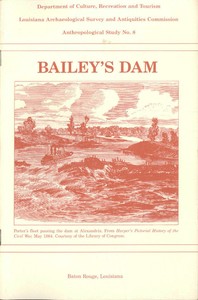
Read on Project GutenbergBailey's Dam, built in 1864 to rescue Union gunboats trapped on the Red River, is examined here through a dual lens: historical documents and archaeological excavation. The authors, Steven D. Smith and George J. Castille III, present findings from 1984 fieldwork that exposed portions of the dam's crib and tree dam sections. This study, published as Anthropological Study No. 8 by the Louisiana Archaeological Survey, moves between engineering diagrams, soldiers' accounts, and the physical remains of logs, bark, and a hewn octagonal column.
Structure and Materials
The dam was not a single construction but a composite of three distinct sections: a crib dam, a tree dam, and a gap closed by sunken coal barges. Excavations revealed that the tree dam used pine and hardwood logs with bark intact, their tops trimmed and pointed with an axe. Surprisingly, many trees were positioned with tops downstream, contrary to historical illustrations. Spaces between logs were packed with sand and mud, then covered with brick and stone. Among the logs, archaeologists found a hewn, octagonal wood column—likely a riverboat mast—rough-cut to fit a specific spot. The crib dam, built of squared timbers in a log-cabin style, measured 40 feet long and 5 feet wide, parallel to the river flow.
Water and Pressure
The dam's effectiveness hinged on rising water. By May 6, 1864, the impounded water had risen 4 feet; two days later it reached 5 feet 4 inches. Pressure built until, at 5:30 a.m. on May 9, an officer heard 'a great crashing' and saw water rushing through as two barges broke loose. Rear Admiral David Porter ordered the gunboat Lexington to run the gap, a maneuver witnessed by 'ten thousand spectators.' The authors note that Bailey had intentionally left one barge only partially filled, hoping to create a controlled breach—a plan that worked, but not as intended.
Archaeological Evidence and Limits
The 1984 excavations faced practical constraints: rising river water forced abandonment of the crib dam unit at 2 feet below water level, despite a pump. Archaeologists could not reach the dam's base. The tree dam excavation exposed logs but no remains of the four coal barges; those were reconstructed from historical photographs. The barges, 24 by 170 feet, were sunk lengthwise and anchored with stone, brick, and iron rails, supplemented by braces and ropes to the banks. The authors thus rely on a blend of physical evidence and period imagery, acknowledging gaps in the archaeological record.
Movement Between Scenes
The narrative shifts between three vantage points: the riverbank during construction, the archaeological trench in 1984, and historical illustrations such as Harper's Pictorial History and Frank Leslie's Illustrated Newspaper. One passage moves from a soldier's eyewitness account—'Jumping out of the blankets and slipping on my coat, cap, and boots, I ran down to the bank'—to a diagram of Porter's fleet passing the dam. This oscillation between personal testimony, physical remains, and visual records gives the study a layered, almost cinematic quality, though the excerpts provide only fragments of the full report.
Readers should approach this study as a technical report that balances engineering analysis with human drama. The authors do not claim to have uncovered the entire dam; instead, they present what survived—logs, a mast, and a partial crib—alongside the words of those who built and breached it. The work invites attention to how archaeological inference and historical narrative can complement each other, especially when the physical evidence is incomplete.
I keep thinking about how Bailey’s Dam made me feel the weight of those old timbers, men working against a river they couldn’t quite trust. That quiet patience reminded me of something else I once picked up — Ancient and modern engineering and the Isthmian canal — Key Ideas to Explore — where the same stubborn hope shows up, just on a bigger scale. Strange how digging and waiting never really change.
There are no reviews for this eBook.
There are no comments for this eBook.
Reader reflection
Take a moment to reflect on this book
Create a short personal record of your experience with this book.
Your progress
0
/
10
2
Was reading this book enjoyable?
3
Would you recommend this book to another reader?
4
How much effort did this book require?
5
How clearly were the main ideas presented?
6
Did any part of the book feel personally relevant?
7
How original did the book feel?
8
Could you apply anything you learned?
9
What changed or sharpened your thinking?
10