1

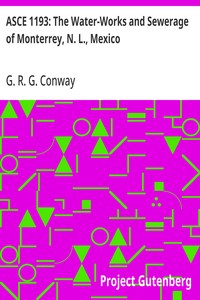
ASCE 1193: The Water-Works and Sewerage of Monterrey, N. L., Mexico The 4th article from the June, 1911, Volume LXXII, Transactions of the American Society of Civil — Inside the Classic
(0 User reviews)
1026
Project Gutenberg
2011
Not confirmed
Water-supply engineering -- Mexico -- Monterrey; Sewerage -- Mexico -- Monterrey
Readers of public-domain and historical texts
Project Gutenberg digital edition
en
Edition facts
Words
41,704
Reading time
182 min
Text sections
7
The source record for ASCE 1193: The Water-Works and Sewerage of Monterrey, N. L., Mexico The 4th article from the June, 1911, Volume LXXII, Transactions of the American Society of Civil — Inside the Classic measures this digital text at 41,704 words, 3 hr 2 min estimated reading time, and 7 detected text sections.
The text analysis averages about 15.3 words per sentence, while the detected sections provide another way to judge how the source is divided.
Project Gutenberg metadata also associates the work with “Water-supply engineering -- Mexico -- Monterrey,” connecting these edition facts with the source record’s subject description.
Source:
Project Gutenberg record #38455
A 1911 civil engineering report detailing the design and construction of Monterrey's water supply and sewerage systems, with precise technical specifications, cost data, and discussion of local geology, labor, and sanitation challenges.
Read the complete public-domain text at its original source.
Read on Project GutenbergThis paper, presented to the American Society of Civil Engineers in February 1911, documents the engineering of Monterrey's water-works and sewerage under a guaranteed concession. The author, G. R. G. Conway, provides exhaustive technical detail—from the geology of the Santa Catarina River valley to the dimensions of concrete reservoirs and the layout of vitrified clay sewers. The text is notable for its precision: pipe diameters are given in both centimeters and inches, flush-tank capacities in liters, and manhole covers weigh exactly 190 kg. Yet the report also reveals the human and political context: the city's founding in 1596, the concession granted by General Bernardo Reyes, and the labor conditions of Mexican workers earning 75 centavos to $1.25 per day.
Geology and Topography as Design Constraints
The report opens with a detailed account of Monterrey's geology, emphasizing the alluvial deposits of the Santa Catarina River and the limestone formations of the surrounding sierras. Conway notes that the river's floodplain posed a risk to water mains, and that the city's natural slope toward the northeast made a gravitation sewer system feasible. The text includes a table of rainfall data (average 600 mm per year) and temperature extremes, linking these to the design of reservoirs and the choice of a separate sewer system that excludes storm-water. The author's attention to local conditions—such as the scarcity of rain for months at a time—shapes every engineering decision.
The Concession and Its Obligations
Conway describes the 1905 concession granted by the state government, which required the company to provide water and sewerage for 30 years, with the right to charge tariffs and the obligation to maintain fire hydrants. The text specifies that the company must supply water to all buildings within the city limits and that the sewerage system must be completed within five years. Notably, the concession exempted the company from handling storm-water, a clause that reflects both the local climate and the legal framework. The author includes the exact tariff rates (e.g., 0.50 pesos per 1,000 liters for domestic use) and sanitary regulations, such as the prohibition of cesspools within the city.
Labor, Materials, and Costs
A section on labor rates reveals that Mexican laborers earned 75 centavos to $1.25 per day, while skilled masons received $1.50 to $2.00. Conway notes that materials like cement were imported from the United States, while sand and stone were sourced locally. The total cost of the works is given as $2,500,000 (Mexican gold), with a breakdown by component: the Estanzuela supply cost $1,200,000, the sewerage system $800,000, and the sewage disposal works $500,000. The author also discusses the challenges of transporting heavy pipes and the use of reinforced concrete tubes for larger diameters, imported from San Antonio, Texas.
Readers interested in the intersection of engineering and urban history will find this report a rich primary source. The discussion section, which includes comments from engineers like James D. Schuyler and Rudolf Meyer, adds a layer of professional debate. Conway's responses clarify design choices, such as the use of Miller flushing siphons and the decision to place manholes every 80 meters. The text rewards careful reading of its tables and plates, which contain data not repeated in the prose.
There’s something poignant in that old report on Monterrey’s sewers—all that faith in pipes and precision laid into dry ground. It reminds me of the quieter stretches in The Railway Conquest of the World — Themes and Context, where engineering becomes a kind of longing. We still live inside those drawings, don’t we? Just built over, now.
There are no reviews for this eBook.
There are no comments for this eBook.
Reader reflection
What was your reading experience?
Capture what you thought, learned, and would like to remember.
Your progress
0
/
10
2
Did this book hold your interest?
3
Would you encourage someone else to read it?
4
What was the reading difficulty like?
5
Did the book give you something worth debating?
6
How original did the book feel?
7
Which part made the strongest impression?
8
How understandable was the text?
9
What did this book teach you most?
10