1

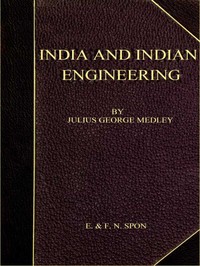
India and Indian Engineering. Three lectures delivered at the Royal Engineer Institute, Chatham, in July 1872 — Background and Themes
(0 User reviews)
626
Project Gutenberg
2017
Not confirmed
Public works -- India -- History -- 19th century; Building -- India -- 19th century; India -- Buildings, structures, etc.; Engineering -- India -- History -- 19th century
Readers of public-domain and historical texts
Project Gutenberg digital edition
en
Edition facts
Words
36,460
Reading time
159 min
Text sections
8
This digital edition of India and Indian Engineering. Three lectures delivered at the Royal Engineer Institute, Chatham, in July 1872 — Background and Themes is described by source-level measurements including 36,460 words, 2 hr 39 min estimated reading time, and 8 detected text sections.
The text analysis averages about 30.5 words per sentence, while the detected sections provide another way to judge how the source is divided.
Project Gutenberg metadata also associates the work with “Public works -- India -- History -- 19th century,” connecting these edition facts with the source record’s subject description.
Source:
Project Gutenberg record #56245
Colonel Medley's 1872 lectures blend technical engineering detail with vivid observations of Indian rivers, construction methods, and Anglo-Indian life, revealing the practical challenges and cultural context of colonial public works.
Read the complete public-domain text at its original source.
Read on Project GutenbergColonel Julius George Medley opens his first lecture by stating two aims: to interest fellow officers in the work of Royal Engineers in India and to offer practical guidance to those about to serve there. The lectures, delivered at the Royal Engineer Institute in Chatham in July 1872, are structured as a syllabus covering India's physical features, people, Anglo-Indian life, government, and a wide range of engineering topics—from building materials and foundations to bridges, railways, and irrigation works. Medley's voice is that of a seasoned practitioner, speaking directly to an audience of military engineers, and his language shifts between broad geographical description and precise technical explanation.
A River's Anatomy: Observation and Hazard
Medley's description of Indian rivers is one of the most vivid passages in the lectures. He traces a river's course from its glacial source at over 20,000 feet, through boulder-strewn torrents, to the plains where the bed changes to shingle and then sand. The river becomes a sluggish, tortuous stream, full of shoals and quicksands, and near its mouth forms a vast delta. He notes that these rivers often run on a ridge, retained by artificial dykes, like the Po and Mississippi. The seasonal cycle is stark: low water in December–February, rising from March to June as snow melts, and prodigious volume in June–August from monsoon rains. Medley reports personal observations: the Indus concentrated in a channel 1000 feet across, and six months later he could not see either bank from mid-stream. In one year, the river cut its way inland a full mile perpendicular to the stream. Such details ground the engineering challenges in lived experience.
Foundations in Treacherous Soil
The difficulty of building foundations in water is a recurring theme. Medley explains that the sudden shifting of a shoal can dam a bridge's archway, and the increased velocity in a narrowed waterway can scour out a hole 30 feet deep in a single night. He states bluntly that almost every rainy season sees failures and disasters, and the most carefully considered design may be a mass of ruins in twenty-four hours. The Bengal method is to carry pier-cylinders down to firm soil or to an absolute depth. He describes the use of well-cylinders, sunk by parties of well-sinkers, and mentions the Solani Aqueduct at Roorkee, where piers were built in a block with hollows and sunk 20 feet. However, he notes that such work requires very experienced men and is subject to risks, so separate wells are generally preferred. The language here is direct and cautionary, reflecting the high stakes of engineering in an unpredictable environment.
Voice of the Practitioner: Audience and Purpose
Medley's narrative voice is shaped by his dual role as instructor and colleague. He addresses his listeners as 'you' and refers to 'your brother officers' working in India, creating a sense of shared professional identity. The lectures are not merely technical; they also convey the peculiarities of Anglo-Indian life, the difficulties of the English in India, and the conservatism of the East. Medley includes practical details such as the cost of living, society in India, and travelling. He mentions the 'old native jham' replaced by a steam-hoist, and refers to the 'Professional Papers' and the Roorkee 'Treatise' as sources for further study. This blend of personal anecdote, technical instruction, and cultural observation gives the lectures a distinctive character—part manual, part travelogue, part professional briefing. The syllabus itself, with its wide-ranging topics, shows Medley's effort to prepare his audience for the diverse duties of an Indian engineer.
Medley's lectures offer a rare window into the mindset of a colonial engineer who must balance theoretical knowledge with the harsh realities of Indian climate and terrain. Readers interested in the history of engineering, British India, or the practical challenges of infrastructure in monsoon environments will find his observations both informative and engaging. The text rewards attention to the interplay between technical detail and personal narrative, revealing how engineering decisions were shaped by local conditions and the limits of 19th-century technology.
Reading Colonel Medley’s lectures, I kept thinking of the slow, careful way old manuals describe tools. His rivers and masonry felt so particular. Later, I found myself browsing the Smithsonian Institution - United States National Museum - Bulletin 240 Contributions From the Museum of History and Technology Papers 34-44 on Science and Technology — Reading Notes, and it struck me—both are simply people recording what they built, hoping someone later might understand the effort.
There are no reviews for this eBook.
There are no comments for this eBook.
Reader reflection
Record your reading impressions
A brief reflection can help important ideas stay with you longer.
Your progress
0
/
10
2
Did this book hold your interest?
3
Would you encourage someone else to read it?
4
How much effort did this book require?
5
Could you follow the author’s main argument?
6
Is this a title worth rereading?
7
Which element worked best for you?
8
Would you start a conversation about this book?
9
Which lesson or insight stayed with you?
10