1

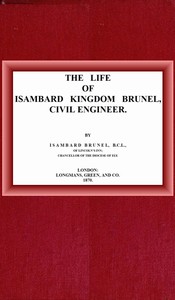
The life of Isambard Kingdom Brunel, Civil Engineer — Inside the Classic
(0 User reviews)
718
Project Gutenberg
2012
Not confirmed
Brunel, Isambard Kingdom, 1806-1859; Civil engineering
Readers of public-domain and historical texts
Project Gutenberg digital edition
en
Edition facts
Words
209,551
Reading time
912 min
Text sections
28
Before opening The life of Isambard Kingdom Brunel, Civil Engineer — Inside the Classic, the edition data offers a quick orientation: 209,551 words, 15 hr 12 min estimated reading time, and 28 detected text sections.
The text analysis averages about 26.1 words per sentence, while the detected sections provide another way to judge how the source is divided.
Project Gutenberg metadata also associates the work with “Brunel, Isambard Kingdom, 1806-1859,” connecting these edition facts with the source record’s subject description.
Source:
Project Gutenberg record #41210
Isambard Brunel's biography of his father, the civil engineer, organizes the life thematically rather than chronologically after 1835, with chapters on railways, bridges, docks, and steamships, including detailed design memoranda for the Great Eastern.
Read the complete public-domain text at its original source.
Read on Project GutenbergIsambard Brunel, the engineer's son and a barrister, opens his biography by explaining that he has not attempted a strict chronological narrative beyond 1835. Instead, the book is arranged thematically: railway works, the broad gauge, atmospheric system, bridges, ocean steam navigation, and docks. This structure reflects the author's decision to group related projects, even when they overlapped in time. The preface acknowledges contributions from William Bell, William Pole, and Captain Claxton, among others, and notes that the author has omitted material to keep the work to a single volume. The result is a biography that prioritizes technical exposition over personal chronology.
A Thematic Rather Than Chronological Life
The preface makes clear that after the early chapters covering 1806–1835, the narrative abandons a linear timeline. Chapter IV, for instance, covers all railway works except bridges, which are reserved for Chapter VII. Chapters VIII–XIII on ocean steam navigation span the same period (1835–1859) as the railway chapters. This arrangement means that the reader encounters the Great Western Railway, the Great Western steamship, and the Great Eastern not in the order they were built but as separate technical subjects. The author acknowledges that he has been compelled to omit much material to fit a single volume, and he takes responsibility for the general arrangement of contributed sections.
Design Memoranda as Primary Evidence
The excerpts include extensive extracts from Isambard Kingdom Brunel's own memoranda, particularly for the Great Eastern. These entries, dated from March to November 1853, record calculations of ship dimensions, engine specifications, and practical concerns such as coal consumption and water supply. One memorandum notes the need for sensitive governors to prevent engines from running away, and another discusses the possibility of using the same water over again through condensation. The inclusion of these raw notes gives the reader direct access to the engineer's working mind, showing how he weighed options like length, beam, and draught against cargo capacity and fuel efficiency.
Recurring Focus on Measurement and Efficiency
Throughout the memoranda, a preoccupation with precise measurement and operational efficiency emerges. Brunel calculates the displacement increase from a slight enlargement of the ship's dimensions, and he proposes a system of tramways and waggons to measure coal consumption hourly. He also considers the use of clean water and cooling to reuse condensation. These details reveal a methodical approach to design, where every ton of displacement and every pound of coal is accounted for. The biography, by reproducing such notes, emphasizes the engineer's relentless drive to optimize performance, even in the preliminary stages of a project.
Collaborative Authorship and Editorial Choices
The preface lists several contributors: William Bell wrote the chapters on bridges and docks, William Pole assisted with the broad gauge chapter, and Mr. Froude contributed on the atmospheric system. The author also acknowledges letters written at his request and the help of Captain Claxton on steam navigation. This collaborative structure means the biography is not a single voice but a composite of expert accounts. The author's role as editor is explicit: he has selected and arranged material, and he thanks those who supplied materials and revised proofs. Readers should be aware that different sections may reflect different perspectives and levels of technical detail.
This biography is best approached as a technical reference organized by project type rather than a personal narrative. Readers interested in the Great Eastern will find concentrated design notes in the steam navigation chapters, while those seeking the broad gauge debate should turn to Chapter V. The preface and chapter summaries provide a useful map for navigating the thematic structure. The book rewards selective reading based on the reader's particular interest in Brunel's diverse works.
There are evenings when I close Brunel’s biography, its careful memoranda on the Great Eastern still humming in my mind, and reach for the quieter ledger of the Scotts at Greenock. The one speaks of ambition’s grand geometry; the other, of patient hulls and steadfast rivets. Together they whisper a shared truth about men who loved the sea’s hard work. Two Centuries of Shipbuilding by the Scotts at Greenock — Context and Discussion feels like an old friend to that famous engineer’s story, bound by the same salt and timber.
There are no reviews for this eBook.
There are no comments for this eBook.
Reader reflection
Your personal reading reflection
Build a private reading journal entry for this title.
Your progress
0
/
10
2
What was your overall reaction to the book?
3
Would you encourage someone else to read it?
4
Did the language feel accessible?
5
How much did the book move you?
6
What did you think about the pace?
7
Would you start a conversation about this book?
8
Did you relate to its people, ideas, or situations?
9
Which lesson or insight stayed with you?
10