1

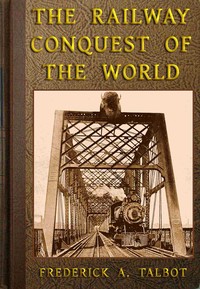
The Railway Conquest of the World — Themes and Context
(0 User reviews)
240
Project Gutenberg
2021
Not confirmed
Railroad engineering -- History; Railroads -- History
Readers of public-domain and historical texts
Project Gutenberg digital edition
en
Edition facts
Words
119,024
Reading time
518 min
Text sections
32
For The Railway Conquest of the World — Themes and Context, the stored edition analysis reports 119,024 words, 8 hr 38 min estimated reading time, and 32 detected text sections.
The text analysis averages about 24.9 words per sentence, while the detected sections provide another way to judge how the source is divided.
Project Gutenberg metadata also associates the work with “Railroad engineering -- History,” connecting these edition facts with the source record’s subject description.
Source:
Project Gutenberg record #66868
Talbot's 1911 survey of global railway construction emphasizes engineering feats over social history, using vivid descriptions of mountain passes, bridges, and tunnels to convey the romance and peril of building steel highways across continents.
Read the complete public-domain text at its original source.
Read on Project GutenbergFrederick A. Talbot opens The Railway Conquest of the World by asserting that railway construction holds “the unfathomable fascination of romance,” yet he immediately acknowledges that passengers in luxurious Pullman cars experience none of the perils faced by builders. This tension between smooth travel and dangerous labor runs through the book. Talbot relies on firsthand accounts from engineers and railway officials, naming contributors such as Norman B. Dickson and William Hood. The narrative focuses on representative projects—the largest and most interesting between the poles—rather than attempting an exhaustive catalog.
Voice of the Engineer-Adventurer
Talbot writes in a confident, slightly breathless tone that blends technical detail with dramatic flourish. He describes the Denver and Rio Grande line crossing the Continental Divide with precise altitudes: Fremont Pass at 11,330 feet, Ibex station at 11,522 feet. But he also reaches for metaphors: a bridge across a gorge is “a swallow’s nest built under the eaves of a roof.” The prose shifts between surveyor’s data and romantic hyperbole. When discussing the Ophir Loop, he notes the 4 percent grade—every 25 feet the train rises 12 inches—then compares the zigzag to the Stelvio road over the Alps. This dual register, part engineer’s report, part adventure tale, defines the book’s narrative voice.
Pace Through Perilous Terrain
The book’s pacing mirrors the landscapes it describes. In the excerpt about the Toltec tunnel, the sentence structure accelerates: “Sudden emergence from the inky blackness of the mountain’s heart to this frail-looking link … is decidedly startling.” Short clauses mimic a train bursting into daylight. Elsewhere, when detailing construction dangers—men slung from derricks, a missed footing meaning “certain death on the splintering crags below”—the rhythm becomes staccato. Talbot uses these shifts to keep the reader engaged, alternating between measured exposition and urgent, almost cinematic description. The effect is a narrative that never settles into a monotone, even when explaining gradients or tunnel lengths.
Recurring Details: Numbers and Nature
Talbot repeatedly anchors his romantic scenes with hard numbers. The Toltec tunnel is “carved through solid granitic rock for some 600 feet”; the Eiffel Tower, if planted in the gorge, would have its top platform “over 500 feet below the railway track.” These comparisons give scale to the sublime. Another recurring motif is the engineer’s ingenuity pitted against natural obstacles: the “Phantom Curve,” the Ophir mountain that “stands directly in the path of the line,” the “swallow’s nest” bridge. Nature is never passive; it is a force that “puzzled sorely” the constructional engineer. Talbot’s world is one where human will and natural resistance are locked in a visible, measurable struggle.
Readers should approach The Railway Conquest of the World as a period piece of engineering enthusiasm, not a modern analytical history. Talbot’s reliance on engineer-contributors means the book privileges the builders’ perspective. The language is of its time—unabashedly celebratory, occasionally imperial in tone. To appreciate the work, focus on the interplay between precise figures and dramatic scene-setting; that tension is the book’s enduring engine.
The rain blurred the window while Talbot’s mountain passes dissolved into steel and steam. Later, the same stubborn silence led me to thread-counting mechanisms, where shuttles replace locomotives. Modern Cotton Spinning Machinery, Its Principles and Construction — Context and Discussion felt less like an industry manual, more like another patient blueprint of human motion — quieter tracks entirely.
There are no reviews for this eBook.
There are no comments for this eBook.
Reader reflection
Before you leave, reflect on the book
Use these questions to collect your thoughts before moving on.
Your progress
0
/
10
2
How much did you enjoy the reading experience?
3
Is this a title you would suggest to others?
4
How demanding did the text feel?
5
What did you think about the pace?
6
Which part made the strongest impression?
7
How closely did the book connect with your experience?
8
Did you gain anything practical from the text?
9
In one sentence, what did you learn?
10