1

Books Relating to Applied Science, Published by E & F. N. Spon, 1887. — Key Ideas to Explore
(0 User reviews)
1663
Project Gutenberg
2019
Not confirmed
Publishers' catalogs -- England -- London; E. & F. N. Spon -- Catalogs; Science -- Bibliography -- Catalogs; Engineering -- Bibliography -- Catalogs
Readers of public-domain and historical texts
Project Gutenberg digital edition
en
Edition facts
Words
11,322
Reading time
50 min
Text sections
9
For Books Relating to Applied Science, Published by E & F. N. Spon, 1887. — Key Ideas to Explore, the stored edition analysis reports 11,322 words, 50 min estimated reading time, and 9 detected text sections.
The text analysis averages about 12.2 words per sentence, while the detected sections provide another way to judge how the source is divided.
Project Gutenberg metadata also associates the work with “Publishers' catalogs -- England -- London,” connecting these edition facts with the source record’s subject description.
Source:
Project Gutenberg record #59308
A 1887 publisher's catalog of scientific and technical books, organized by subject, with detailed entries on chemistry, engineering, electricity, and more, reflecting late-Victorian applied science.
Read the complete public-domain text at its original source.
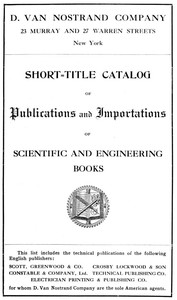
Read on Project GutenbergThis 1887 catalog from E. & F. N. Spon presents a dense inventory of scientific and technical works, each entry a compact advertisement of contents, editions, and prices. The listings are notably precise: Thomas Bayley's Pocket-Book for Chemists runs to 437 pages in royal 32mo, while Cameron Knight's The Mechanician boasts 1,147 illustrations across 397 pages. The catalog's voice is brisk and factual, yet occasionally punctuated by quoted praise, as when Hurst's Handbook of Formulæ is called “the very best of them all.”
Structure and Scope of the Catalog
The catalog is organized by subject area rather than alphabetically, grouping titles under headings like “Electrical Technology” and “Mechanical Engineering.” Each entry follows a consistent pattern: author, title, edition, page count, format, binding, and price. Some entries include a synopsis of contents, as with Bayley's Pocket-Book, which lists over twenty topics from atomic weights to photography. Others, like Dynamo-Electricity by G. B. Prescott, simply note the number of illustrations (545) and price (1 l. 1 s.). This uniformity suggests the catalog was designed for quick reference by professionals—engineers, chemists, builders—who needed to assess a book's utility at a glance.
Language and Descriptive Techniques
The catalog's language is utilitarian but not without flair. Descriptions rely on concrete details: a book is “royal 32mo, roan, gilt edges,” measuring “5 in. by 3 in., and about ¾ in. thick.” The phrase “limp cover” conveys portability. When quoting external reviews, the catalog shifts to a more evaluative tone, as in the praise for Hurst's handbook. Some titles use vivid phrasing: Wrinkles in Electric Lighting suggests practical tips, while Health and Comfort in House Building promises both. The catalog also employs repetition of key selling points—edition numbers, illustration counts, and format sizes—to emphasize authority and comprehensiveness.
Pacing and Reader Engagement
The catalog's pace is steady, with each entry given roughly equal weight, but variation comes from entry length. Short entries, like On Designing Belt Gearing at 6 d., are brisk; longer ones, such as Spons’ Dictionary of Engineering spanning 3,100 pages, slow the reader with their heft. The inclusion of contents lists in some entries (e.g., Algebra Self-Taught with its fourteen topics) creates a rhythm of detail and pause. The catalog occasionally breaks from listings with a quoted endorsement, offering a momentary shift in voice. This structure guides the reader through a vast array of titles without overwhelming, balancing density with clarity.
Readers approaching this catalog should note its dual purpose: it is both a sales document and a snapshot of late-19th-century technical knowledge. The entries reward close attention to format and price, which signal a book's intended audience—pocket-sized guides for practitioners, multi-volume sets for libraries. The catalog's lack of narrative or authorial commentary leaves the titles to speak for themselves, making it a primary source for understanding how applied science was packaged and marketed in 1887.
That 1887 Spon catalog, all patient columns of boilers and dynamos, always made me think of boys with smudged fingers and bright eyes. It promised a world of making things. And next to it, somehow, sits its younger, friendlier echo: The Boy Electrician — A Closer Reading, where those industrial promises become a single spark, quietly cupped in a young hand.
There are no reviews for this eBook.
There are no comments for this eBook.
Reader reflection
Before you leave, reflect on the book
Use these questions to collect your thoughts before moving on.
Your progress
0
/
10
2
What was your overall reaction to the book?
3
How likely are you to recommend this book?
4
How easy was the book to follow?
5
Would you like to discuss this book with someone?
6
How understandable was the text?
7
Did the book meet your expectations?
8
Did the book offer a fresh perspective?
9
In one sentence, what did you learn?
10