1

Short-Title Catalog of Publications and Importations of Scientific and Engineering Books (August 1910) — Edition Insights
(0 User reviews)
355
Project Gutenberg
2017
Not confirmed
Booksellers' catalogs -- New York (State) -- New York; Publishers' catalogs -- New York (State) -- New York; Science -- Bibliography -- Catalogs; D. Van Nostrand Company -- Catalogs; Engineering -- Bibliography -- Catalogs
Readers of public-domain and historical texts
Project Gutenberg digital edition
en
Edition facts
Words
10,793
Reading time
47 min
Text sections
2
This digital edition of Short-Title Catalog of Publications and Importations of Scientific and Engineering Books (August 1910) — Edition Insights is described by source-level measurements including 10,793 words, 47 min estimated reading time, and 2 detected text sections.
The text analysis averages about 6.3 words per sentence, while the detected sections provide another way to judge how the source is divided.
Project Gutenberg metadata also associates the work with “Booksellers' catalogs -- New York (State) -- New York,” connecting these edition facts with the source record’s subject description.
Source:
Project Gutenberg record #53911
This 1910 catalog from D. Van Nostrand Company lists scientific and engineering books, including imports from British publishers. It reveals the era's technical priorities through pricing, binding notes, and subject range, from electrical railways to chemical analysis.
Read the complete public-domain text at its original source.
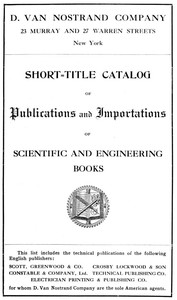
Read on Project GutenbergD. Van Nostrand Company's August 1910 catalog presents a snapshot of early twentieth-century technical publishing, listing hundreds of titles across engineering, chemistry, electricity, and applied sciences. The catalog's structure—alphabetical by author, with occasional cross-references—reflects a practical, no-nonsense approach to information organization. Notably, the company served as sole American agent for several British publishers, including Scott, Greenwood & Co. and Constable & Company, Ltd., indicating a transatlantic flow of technical knowledge. Prices marked with an asterisk denote net pricing, and bindings are cloth unless otherwise noted, suggesting a standardized, durable product for professional use.
Pricing and Binding as Indicators of Audience
The catalog uses a clear pricing code: an asterisk marks net prices, while unmarked titles likely allowed trade discounts. This distinction hints at two markets—institutional buyers (libraries, firms) and individual professionals. Bindings are uniformly cloth except where noted (e.g., half morocco for Newlands's Carpenters and Joiners’ Assistant at $15.00, a premium item). Leather bindings appear for pocketbooks like O'Connor's Gas Engineer’s Pocketbook ($3.50), emphasizing portability and durability. Paper covers are rare, used for Olsson's Motor Control ($0.50), a U.S. Navy series pamphlet. These material choices signal expected use: reference works in cloth, field guides in leather, and ephemeral reports in paper.
Subject Clusters and Missing Entries
The catalog's alphabetical arrangement creates unintentional subject clusters. Under 'A,' electrical engineering dominates (Abbott, Alexander, Anderson), alongside chemistry (Aikman, Andés) and practical crafts (Adam on bookbinding). The 'P' section reveals a strong focus on measurement and instruments: Pickworth's Indicator Handbook, Logarithms for Beginners, and The Slide Rule appear alongside Perry's Applied Mechanics. Notably, several entries are marked 'In Press' or 'In Preparation,' such as Parshall and Parry's Electrical Equipment of Tramways and Phin's Household Pests. These gaps remind readers that the catalog captures a moment of active publishing, not a static list.
Transatlantic Knowledge Transfer
The title page explicitly names five British publishers for whom D. Van Nostrand acted as sole American agent, including the Electrician Printing & Publishing Co. and Crosby Lockwood & Son. Many titles are translations: Adam's Practical Bookbinding from French, Andés's works on fats and oils from German, and Neuberger and Noalhat's Technology of Petroleum from French. Translators are credited, such as C. Salter and J. G. McIntosh, indicating a systematic effort to make European technical literature accessible to American readers. This importation network suggests that early 20th-century American engineering relied heavily on European expertise, particularly in specialized fields like petroleum technology and industrial chemistry.
Readers approaching this catalog should treat it as a primary source for the history of technology and publishing. The list's omissions—no entries for aeronautics beyond Petit's How to Build an Aeroplane—are as telling as its inclusions. Cross-references like 'A B C Code. (See Clausen-Thue.)' hint at a networked knowledge system. For researchers, the catalog offers a baseline for studying the diffusion of technical knowledge across the Atlantic in the decade before World War I.
That old Van Nostrand catalog always made me feel the patient weight of human hands—each binding a promise of use. Flipping through it now, I recall a quieter tome beside it on my shelf, one that dreams of taming the river’s stubborn tide. The Great Thames Barrage — Themes and Context shares that same unhurried confidence, a faith in measured human endeavor.
There are no reviews for this eBook.
There are no comments for this eBook.
Reader reflection
Record your reading impressions
A brief reflection can help important ideas stay with you longer.
Your progress
0
/
10
2
Did this book hold your interest?
3
Is this a title you would suggest to others?
4
What was the reading difficulty like?
5
Would this book work well in a reading group?
6
Is this a title worth rereading?
7
How did the pace of the book feel?
8
Was the book what you thought it would be?
9
What did this book teach you most?
10