1

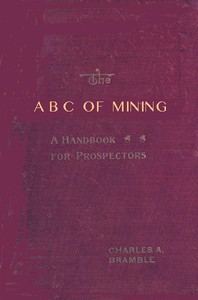
The A B C of Mining: A Handbook for Prospectors — Story, Setting & Ideas
(0 User reviews)
269
Project Gutenberg
2014
Not confirmed
Mining engineering; Prospecting
Readers of public-domain and historical texts
Project Gutenberg digital edition
en
Edition facts
Words
43,342
Reading time
189 min
Text sections
5
For The A B C of Mining: A Handbook for Prospectors — Story, Setting & Ideas, the stored edition analysis reports 43,342 words, 3 hr 9 min estimated reading time, and 5 detected text sections.
The text analysis averages about 17.7 words per sentence, while the detected sections provide another way to judge how the source is divided.
Project Gutenberg metadata also associates the work with “Mining engineering,” connecting these edition facts with the source record’s subject description.
Source:
Project Gutenberg record #45287
A practical 1898 handbook for prospectors, emphasizing simple tools, observation, and experience over formal engineering, with detailed guidance on testing ores, field geology, and placer mining.
Read the complete public-domain text at its original source.
Read on Project GutenbergCharles A. Bramble addresses his handbook directly to "shrewd, intelligent men without experience in prospecting," promising a "safe guide" to an arduous pursuit. The book opens by distinguishing the prospector's role from the mining engineer's: the prospector discovers deposits; the engineer develops them. Bramble insists that many successful discoverers were "entirely ignorant" of mine development methods. The most valuable assets, he writes, are "a few simple tools and a not very deep knowledge of assaying, with an observant eye and a brain quick to deduce inferences." Experience, he adds, teaches what no college or book can.
A Practical Philosophy of Prospecting
Bramble repeatedly stresses that formal education is secondary to field experience. He notes that each mining district differs, implying that local knowledge outweighs universal theory. The handbook's structure itself reflects this pragmatism: chapters move from prospecting and testing to camp life, surveying, and even medical hints. The author's own background as a Crown Lands and Mineral Surveyor for Canada and a former editor of The Engineering and Mining Journal lends authority, yet he deliberately avoids technical jargon, providing a glossary for unavoidable terms. The preface to the second edition mentions that the author was "in a very remote region" during the first printing, which allowed compositors' errors to creep in—a detail that underscores the practical, field-based nature of the work.
Ore Descriptions Rooted in Specifics
The handbook's treatment of individual ores is notably concrete. For tin, Bramble warns that it will be "one of the latest ores the young prospector will find himself able to name with certainty," and he gives a distinctive test: scratching the metal with a knife point yields a "whitey-gray" streak. He notes that tin is not found native, that cassiterite must be roasted, and that a vein must yield more than five percent metal to be profitable. For silver, he provides a table of commercial ores with their chemical formulas and silver percentages, then adds that silver is never found in placer deposits because it breaks up under water and air. He also cites specific production figures—the Anaconda mine's 1896 output of 5,000,000 ounces of silver and 125,350,693 pounds of copper—grounding the advice in contemporary industrial reality.
The Prospector's Toolkit: Observation Over Equipment
Bramble's ideal prospector relies on keen observation and simple tools. The opening chapter emphasizes "an observant eye and a brain quick to deduce inferences" as the most valuable assets. The book includes chapters on blow-pipe tests, chemical analysis, and assay methods, but these are presented as accessible skills rather than esoteric science. The glossary defines scientific terms, and the chapter on "Odds and Ends" suggests a miscellaneous collection of practical tips. Even the chapter on dynamite is included not as a technical manual but as a safety and utility guide. Throughout, Bramble maintains that the prospector's work ends where the engineer's begins—a clear division of labor that keeps the handbook focused on discovery, not development.
Bramble's handbook is best read as a period artifact of mining culture at the turn of the century, when individual prospectors still hoped to strike it rich with little more than a pick, a pan, and a sharp eye. The book's value lies not in its scientific depth—which is deliberately elementary—but in its concrete, experience-based advice and its clear-eyed assessment of what a beginner needs to know. Readers interested in the history of mining or in the practical mindset of nineteenth-century prospectors will find this a revealing document.
Reading this old prospector’s handbook, I remembered my grandfather’s worn field gloves and how he’d tap rocks with a hammer, listening. There’s a similar quiet faith in patience, in small tools and careful attention, that I found again in Masters of Space Morse and the Telegraph; Thompson and the Cable; Bell and the Telephone; Marconi and the Wireless Telegraph; Carty and the Wireless Telephone — A Closer Reading — both books trust the steady hand over the grand gesture.
There are no reviews for this eBook.
There are no comments for this eBook.
Reader reflection
Your personal reading reflection
Build a private reading journal entry for this title.
Your progress
0
/
10
2
How did the book work for you overall?
3
Would you encourage someone else to read it?
4
How much effort did this book require?
5
Could you follow the author’s main argument?
6
Could you see yourself revisiting this book?
7
Did any part of the book stay with you emotionally?
8
Was the book what you thought it would be?
9
In one sentence, what did you learn?
10