1

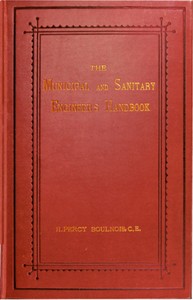
The Municipal and Sanitary Engineer's Handbook — Context and Discussion
(0 User reviews)
625
Project Gutenberg
2017
Not confirmed
Sanitary engineering; Municipal engineering
Readers of public-domain and historical texts
Project Gutenberg digital edition
en
Edition facts
Words
128,879
Reading time
561 min
Text sections
19
Before opening The Municipal and Sanitary Engineer's Handbook — Context and Discussion, the edition data offers a quick orientation: 128,879 words, 9 hr 21 min estimated reading time, and 19 detected text sections.
The text analysis averages about 27.4 words per sentence, while the detected sections provide another way to judge how the source is divided.
Project Gutenberg metadata also associates the work with “Sanitary engineering,” connecting these edition facts with the source record’s subject description.
Source:
Project Gutenberg record #55935
A practical reference for late-19th-century municipal engineers, detailing duties, street construction, and byelaw enforcement through specific clauses and specimen reports.
Read the complete public-domain text at its original source.
Read on Project GutenbergBoulnois opens his handbook with a frank admission: he wrote it because he often wished for a practical book of reference while serving as a borough surveyor. The preface, dated Portsmouth, May 1883, signals that the work is grounded in daily administrative and technical challenges rather than abstract theory. The table of contents immediately reveals a methodical structure, beginning with the legal status of the town surveyor and moving through traffic, road construction, and building regulations. The author’s own credentials—M. Inst. C.E., M. San. Inst., and author of works on dustbins and sewer gases—underscore the applied, hands-on orientation of the volume.
The Surveyor’s Legal and Administrative Framework
The first three chapters establish the surveyor’s position within the Public Health Act 1875. Boulnois quotes the Act directly, noting that the office of surveyor was first legalised by that legislation. He reproduces specimen reports and lists of duties, and discusses the examination system of the Sanitary Institute of Great Britain. The tone is that of a senior practitioner advising juniors: he warns against canvassing for appointments and stresses punctuality and methodical habits. The excerpts show a preoccupation with legal protection—or the lack of it—for surveyors, citing Mr. Lewis Angell on the subject. Boulnois argues that government refusal to grant protection will eventually change, a prediction that frames the handbook as both a manual and a professional manifesto.
Traffic and Roadway Design
Chapter IV, on traffic, opens with a list of interests involved in street construction and maintenance. Boulnois discusses the wearing effect of traffic, Mr. Deacon’s standard, and the effect of horses’ hoofs on roadways, including remarks on shoeing. He provides tables of resistance and tractive force, and cites Mr. Haywood on safety. The chapter includes practical details such as safe width of roadways, sanctuaries for pedestrians, and the danger of crossings. The language is technical but accessible: gradients, wheel resistance, and stopping distances are explained with reference to contemporary engineering authorities. Boulnois’s approach is to combine empirical data with legal requirements, showing how the surveyor must balance engineering principles with public safety.
Macadamised Roads and Construction Specifications
Chapter V contrasts older and modern specifications for macadamised roads. Boulnois notes that macadamised roads were once considered a luxury, and compares Telford’s system with Macadam’s. He reproduces a specification from fifty years ago alongside a modern one, highlighting the advantages of Telford’s method, hard core, and concrete. The chapter is a case study in how engineering practice evolved over the nineteenth century. Boulnois does not simply describe; he evaluates, recommending concrete as a base and explaining why Telford’s system offers better drainage and durability. The excerpts show a writer who expects his reader to be familiar with construction sites and who values practical experience over textbook theory.
Byelaws and Building Control
The later excerpts focus on the surveyor’s duties under the Public Health Act regarding new streets and buildings. Boulnois quotes the Act’s clause 158, which gives the urban authority power to pull down work not conforming to byelaws. He then outlines the surveyor’s tasks: examining plans, supervising construction, and enforcing standards. A specimen byelaw clause is given in full, specifying the scale of plans (not less than 1 inch to 44 feet for streets, 1 inch to 8 feet for buildings), the required details (levels, drainage, materials), and the need for block plans showing adjoining properties. The language is precise and legalistic, reflecting the surveyor’s role as an enforcer of regulations. Boulnois emphasises that these duties are among the most arduous and irksome, a candid admission that humanises the technical content.
Boulnois’s handbook rewards a selective reading: the table of contents and chapter headings allow quick navigation to specific topics, while the frequent legal quotations and specimen forms provide templates for real-world use. Readers interested in the professionalisation of municipal engineering will find the early chapters on the surveyor’s status and duties particularly revealing. The work is best approached as a period document that captures the intersection of law, administration, and engineering in late-Victorian Britain.
That grey afternoon, the Handbook sat open on my lap, its byelaw clauses and street cross-sections oddly soothing against the drumming rain. I found myself lingering on a clause about river outfalls, then wondering what those engineers would have made of a grand scheme to hold the Thames back entirely. The thought carried me quietly to The Great Thames Barrage — Themes and Context. Water, I suppose, always finds its way somewhere else.
There are no reviews for this eBook.
There are no comments for this eBook.
Reader reflection
Take a moment to reflect on this book
Create a short personal record of your experience with this book.
Your progress
0
/
10
2
Did this book hold your interest?
3
Would you recommend this book to another reader?
4
Did the language feel accessible?
5
Did any part of the book feel personally relevant?
6
Did you gain anything practical from the text?
7
Was the book moving at the right speed?
8
Did the book deliver what you hoped for?
9
What is the main idea you are taking away?
10