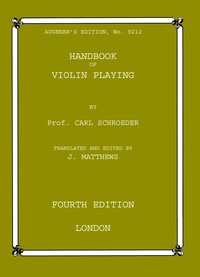
Handbook of violin playing by Carl Schroeder

(6 User reviews)   5529
Schroeder, Carl, 1848-1935 Schroeder, Carl, 1848-1935
English
Overview: A seminal instructional text in the music education genre, Carl Schroeder’s handbook distills late 19th-century German violin pedagogy into a sys...
Share

Read "Handbook of violin playing by Carl Schroeder" Online

This book is available in the public domain. Start reading the digital edition below.

START READING FULL BOOK
Instant Access    Mobile Friendly

Book Preview

A short preview of the book’s content is shown below to give you an idea of its style and themes.

Illustrations have been moved so they do not break up paragraphs. Old or antiquated spellings have been preserved. Typographical and punctuation errors have been silently corrected. _AUGENER’S EDITION, No. 9212._ HANDBOOK OF VIOLIN PLAYING BY Prof. CARL SCHROEDER TRANSLATED AND EDITED BY J. MATTHEWS WITH AN APPENDIX CONSISTING OF A GUIDE THROUGH VIOLIN LITERATURE AND A CHAPTER ON THE VIOLA _FOURTH EDITION_ [Illustration] AUGENER LTD. LONDON Printed in England. CONTENTS. PART I. The instrument. page Origin of the violin 1 The oldest violins 1 Development and perfecting of the violin 2 Prominent makers of the present day 3 Attempts at improving the violin 4 Search for the discovery of the old Italian makers’ secrets 6 Distinguishing features of the old Italian violins 7 Imitations of the old Italian violins 10 Constituent parts of the violin 10 Function of the soundpost and bass bar 12 Position of the bridge 12 Amount of pressure on the upper table 13 Dimensions of the violin 13 The wood 13 The varnish 14 The strings 14 Strings pure in fifths 15 The string gauge 15 Preservation of the strings 16 The bow 16 Different parts of the bow 17 Resin 18 Violin cases 18 Price of violins 19 Price of violin cases 19 Price of bows 19 Preservation of the instrument 19 Cleaning the hair of the bow 20 Names of the strings, and tuning 20 Compass of the violin 21 PART II. The technique of violin playing. Position of the player 22 Holding the violin 22 Position of left hand and arm 23 Holding the bow 25 Position of right hand and arm 25 Examining the manner of holding 25 Bowing 25 Principal signs used for the left hand and for bowing 27 Employment of up and down bows 28 The first exercises 29 Placing the fingers 30 Exercise in intervals 33 Chords in arpeggio 35 Stretching the 4ᵗʰ finger 36 Various styles of bowing and their signs 37 Arpeggi 41 The close shake (vibrato) 42 The open shake 42 The mordent 44 The double shake 44 Scale playing 45 Fingering of scales 46 Chromatic scales 47 The positions 48 Changing the position 49 Movement of the fingers in changing positions 49 Diagram showing the positions 50 Double stops 53 Chords in three parts 58 Chords in four parts 62 Harmonics 64 Pizzicato 69 PART III. The performance. Artistic rendering 72 Taste 72 Individuality 73 Phrasing 73 APPENDIX. Pictorial representation of the bowing 80 The mute 81 The Vibrator 82 Alphabetical list of celebrated violinists of the 17ᵗʰ, 18ᵗʰ and 19ᵗʰ centuries 84 Violinists of the 20ᵗʰ century 106 TRANSLATOR’S APPENDIX. The Viola 107 Guide through Violin literature 109 Guide through Viola literature 179 PART I. The instrument. Origin of the violin. The invention of stringed instruments is certainly of great antiquity, but exact information with regard to the origin of the violin has not come down to us. Although stringed instruments were in use before Christian times, we know that these had nothing in common with the violin, or that at any rate the bow was not then known. It is therefore presumed that its invention and use in connection with stringed instruments occurred in the first century of the Christian era. Many are, notwithstanding, of the opinion that the use of the bow was known in pre-Christian times,—in India and in Persia. Pictures of Indian and Persian bowed instruments exist, but the period when they were employed is not exactly known. See Fig. _a_ and _b_ of page 2. The oldest violins known are those of the Tyrolese Lute maker Gaspard Duiffopruggar...

This is a limited preview. Download the book to read the full content.

Overview: A seminal instructional text in the music education genre, Carl Schroeder’s handbook distills late 19th-century German violin pedagogy into a systematic guide for serious students, focusing on technical mastery and artistic principles.

Plot: The book methodically progresses from foundational posture and bow grip through scales and études, culminating in advanced discussions of phrasing, ornamentation, and interpretation. It is less a narrative and more a carefully plotted course of study, with each chapter building upon the last to form a complete technical and musical framework.

Analysis: Its status as a classic stems from its remarkable synthesis of rigor and musicality. Schroeder avoids mere dry exercise, instead contextualizing technique as the essential vehicle for expression. While modern methods have evolved, this handbook remains a vital historical document, capturing the pedagogical ethos of its era and providing a clear, uncompromising benchmark for disciplined practice. Its enduring value lies in its timeless core philosophy: that flawless technique must always serve the music.


✅ Usage Rights

This digital edition is based on a public domain text. Thank you for supporting open literature.

Jennifer King
1 year ago

Citation worthy content.

Charles Harris
1 year ago

I was skeptical at first, but the arguments are well-supported by credible references. Exactly what I needed.

Lisa Williams
1 year ago

Loved it.

Joseph King
10 months ago

Perfect.

Mary Jones
10 months ago

This book was worth my time since the character development leaves a lasting impact. Absolutely essential reading.

4.5
4.5 out of 5 (6 User reviews )

Add a Review

Your Rating *
There are no comments for this eBook.
You must log in to post a comment.
Log in


Related eBooks