1

Mine Pumping in Agricola's Time and Later — Key Ideas to Explore
(0 User reviews)
1451
Project Gutenberg
2010
Not confirmed
Mining machinery -- History; Mine pumps -- History
Readers of public-domain and historical texts
Project Gutenberg digital edition
en
Edition facts
Words
6,615
Reading time
29 min
Text sections
1
For Mine Pumping in Agricola's Time and Later — Key Ideas to Explore, the stored edition analysis reports 6,615 words, 29 min estimated reading time, and 1 detected text section.
The text analysis averages about 20.5 words per sentence, while the detected sections provide another way to judge how the source is divided.
Project Gutenberg metadata also associates the work with “Mining machinery -- History,” connecting these edition facts with the source record’s subject description.
Source:
Project Gutenberg record #31024
An examination of early mine-pumping technology, challenging the over-reliance on Agricola's 16th-century descriptions by tracing the evolution of water-removal machines from Roman screws to 18th-century innovations, using numismatic and textual evidence.
Read the complete public-domain text at its original source.
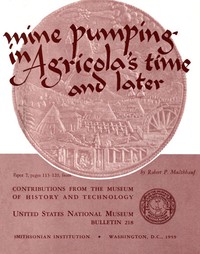
Read on Project GutenbergMulthauf opens with a striking claim: historians have leaned so heavily on Georgius Agricola's De re metallica (1556) that they have oversimplified the development of mining machinery. He argues that this reliance has hardened into a conviction that techniques remained static for centuries after Agricola. The study itself was sparked by 16th-century German coins—detailed mining landscapes on numismatic artifacts—which the curator of numismatics brought to Multhauf's attention. This unusual starting point signals the author's method: he will use material evidence alongside textual sources to complicate the standard narrative.
The Limits of Agricola's Authority
Multhauf identifies a persistent historiographic problem: Agricola's elegant descriptions have inhibited investigation of what came before and after. He names recent accounts by Parsons, Wolf, and Bromehead as perpetuating this over-simplification. The author does not dismiss Agricola but insists that his work should be a starting point, not a terminus. The essay's footnotes reveal a dense network of German-language sources—Veith's Bergwörterbuch, Calvör's Acta historico-chronologico-mechanica, and Rössler's Speculum metallurgiae—that Multhauf uses to reconstruct a more fragmented, contested history. He notes that even the term Kunst (art) in German mining terminology emerged alongside the application of water power to pumping, a linguistic clue to technological change.
Terminological Tangles: Heinzen, Taschen, and Bulgenkunst
Multhauf carefully unpacks the shifting meanings of machine names. The Taschenkunst (pocket-work) was used with a pipe like the rag-and-chain pump, but Calvör and others applied it to the ordinary chain of dippers. Agricola's contemporary Mathesius equated the Kehrrad (reversing wheel) to the Bulgenkunst. Sebastian Münster had mentioned its use in Meissen mines by 1558, and Otto Vogel dated its introduction to as early as 1500. This terminological precision is not pedantry: it reveals that different authors described overlapping devices with different names, obscuring the timeline of innovation. Multhauf shows that the crank, though centuries old, was applied to pumping in mining only after Agricola's time, despite appearing in a 1405 drawing of an Archimedean screw turned by a crank.
The Material Record: Coins, Sketches, and Travel Reports
The essay draws on diverse evidence beyond texts. The 16th-century German coins that initiated the study are themselves artifacts of mining self-representation. A sketch from 1784–85, reproduced in Matschoss's 1909 work, documents the Rosskunst (horse windlass), whose introduction Multhauf links to the earlier term Göpel. Edward Browne's 1673 travel report from Hungary and the Erzgebirge says little about machinery, a silence that Multhauf treats as significant. The Mittelalterliche Hausbuch (1480) shows a crank-and-rod arrangement similar to Agricola's but not in mining service, suggesting that mining technology borrowed from other crafts. Multhauf's method is cumulative: he assembles fragments—a coin, a sketch, a marginal note—to build a case for continuous, if uneven, innovation.
The Long Arc of Mechanization: From Romans to the 18th Century
Multhauf frames the history of mining technology as primarily a history of mechanization, centered on what Agricola called tractorae—hauling machines. Romans used Archimedean screws and norias for dewatering, but evidence of survival beyond the fall of Rome is lacking. The revival of mining in German-speaking central Europe from the 10th century, with intensive development in the Erzgebirge by the 13th, paralleled political and cultural revival. Yet the critical point came when surface deposits were exhausted, forcing deeper mining and the construction of supported tunnels and machinery. Bechtel dated this shift from the mid-14th century, though the Black Death complicates the picture. Multhauf traces the Stangenkunst (rod engine) through modifications described by Lohneyss (1617), Rössler (1700), and Calvör (1763), and notes that ore hauling remained as Agricola showed until the end of the 17th century, when Christopher Polhem built a water-powered conveyor at Falun in 1694.
Multhauf's essay is a model of how to use fragmentary evidence to challenge a settled narrative. Readers should pay attention to the footnotes, where the real argument unfolds: a web of German-language sources, numismatic clues, and obscure technical terms that together reveal a more complex history than Agricola alone can provide. The author does not claim to have the full story, but he shows where to look for it.
It struck me, turning those pages on old mine pumps, how much quiet ingenuity goes unremarked—the same steady patience I find in Mechanics of the Household A Course of Study Devoted to Domestic Machinery and Household Mechanical Appliances — Context and Discussion. Both speak of humble, faithful machines, easing burdens we’ve long forgotten were heavy.
There are no reviews for this eBook.
There are no comments for this eBook.
Reader reflection
What was your reading experience?
Capture what you thought, learned, and would like to remember.
Your progress
0
/
10
2
Did this book hold your interest?
3
How likely are you to recommend this book?
4
How much effort did this book require?
5
How well did it match your expectations?
6
What was the strongest part of the book?
7
Did it raise ideas you would like to talk about?
8
What did you think about the pace?
9
What did this book teach you most?
10