1

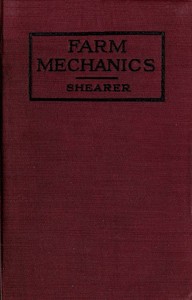
Farm Mechanics: Machinery and Its Use to Save Hand Labor on the Farm. — Themes and Context
(0 User reviews)
58
Project Gutenberg
2012
Not confirmed
Agricultural machinery
Readers of public-domain and historical texts
Project Gutenberg digital edition
en
Edition facts
Words
54,875
Reading time
239 min
Text sections
9
This digital edition of Farm Mechanics: Machinery and Its Use to Save Hand Labor on the Farm. — Themes and Context is described by source-level measurements including 54,875 words, 3 hr 59 min estimated reading time, and 9 detected text sections.
The text analysis averages about 18.2 words per sentence, while the detected sections provide another way to judge how the source is divided.
Project Gutenberg metadata also associates the work with “Agricultural machinery,” connecting these edition facts with the source record’s subject description.
Source:
Project Gutenberg record #39791
Herbert A. Shearer's 1918 manual contrasts old and new farm methods, emphasizing mechanical knowledge and labor-saving machinery. Excerpts detail tripod beef gins, dynamite stump removal, and grain elevators, with precise cost-per-bushel calculations and building-integration advice.
Read the complete public-domain text at its original source.
Read on Project GutenbergHerbert A. Shearer opens Farm Mechanics with a blunt premise: more mechanical knowledge is required on the farm than in any other line of business. The preface contrasts farmers who are natural mechanics with those who merely have an eye for labor-saving tools. The book aims to fit quick-acting machines into daily farm routine, lift heavy loads from men and women, and improve the soil while producing more abundantly. Shearer explicitly states that illustrations explain principles rather than recommend specific machines, and that the old is contrasted with the new, with merits of both expressed.
Contrasts Between Natural Mechanics and Practical Buyers
Shearer draws a sharp distinction between two types of farmers: those who are natural mechanics and those who learn how to buy and operate the best machinery. He notes that some farmers who make the least pretensions have the best implements—they may not be good mechanics, but they recognize value in labor-saving tools. This tension runs through the excerpts, where technical know-how is valued but not required for every task. The preface warns that a farmer who is not mechanically inclined must employ someone who is, framing mechanical skill as a necessity rather than a luxury. The book itself is positioned as a bridge for those who lack innate mechanical talent but need to understand machinery well enough to select, operate, and maintain it.
From Tripod Beef Gins to Dynamite Stumps
The excerpts reveal a striking range of machinery, from simple tripod beef gins to dynamite for stump removal. The tripod, made of three poles tied together, was used to elevate a butchered animal by moving the feet closer together as skinning proceeded. In contrast, dynamite is described as not dangerous since the invention of safety devices, and an expert can blow a stump to pieces so thoroughly that the parts are easily worked into stove lengths. Shearer also notes that pitch-pine stumps have a chemical value that made some fellows rich by operating a retort. These examples show the book's scope from low-tech solutions to explosive power, all framed as labor-saving innovations.
Precision in Cost and Building Integration
Shearer provides specific cost data: shoveling corn by hand costs from 1 to 1½ cents per bushel, but the greatest saving is in time. He describes grain elevators that can be portable or stationary, and emphasizes that technical building knowledge is required to properly connect the building and elevating machinery so that the two work smoothly together. The excerpts detail how a two-story corncrib with a driveway, concrete floor, and pit allows dumping a load without using a shovel or corn fork, and a boy can drive a horse in a circle while buckets carry grain to bins. Shearer insists that certain building features must conform to the requirements and peculiarities of the elevating machinery, showing a systems-level approach to farm efficiency.
Readers should approach Farm Mechanics as a practical manual rooted in early twentieth-century conditions, not a modern guide. Shearer's emphasis on contrasting old and new methods, his precise cost calculations, and his insistence on integrating machinery with building design offer a window into the mindset of agricultural modernization. The book rewards attention to its specific examples—tripod gins, dynamite stumps, grain elevators—rather than general principles. Expect detailed illustrations and a no-nonsense tone that treats machinery as a tool for lifting heavy loads from human shoulders.
There is a quiet kinship between Shearer’s manual and Pumps and Hydraulics, Part 1 (of 2) — Inside the Classic, both speaking of water and iron with the same patient honesty. They never shout for attention, just sit on the shelf, old friends who understand that a farm’s true strength lies in knowing how things work, gently, without fuss.
There are no reviews for this eBook.
There are no comments for this eBook.
Reader reflection
Your personal reading reflection
Build a private reading journal entry for this title.
Your progress
0
/
10
2
How did the book work for you overall?
3
Would you encourage someone else to read it?
4
How easy was the book to follow?
5
Would you start a conversation about this book?
6
What was the strongest part of the book?
7
Could you follow the author’s main argument?
8
How would you rate its originality?
9
What did this book teach you most?
10