1

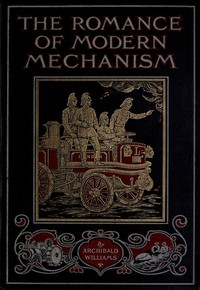
The Romance of Modern Mechanism With Interesting Descriptions in Non-technical Language of Wonderful Machinery and Mechanical Devices and Marvellously Delicate — Background and Themes
(0 User reviews)
351
Project Gutenberg
2014
Not confirmed
Machinery; Electric machinery
Readers of public-domain and historical texts
Project Gutenberg digital edition
en
Edition facts
Words
100,463
Reading time
437 min
Text sections
39
The Romance of Modern Mechanism With Interesting Descriptions in Non-technical Language of Wonderful Machinery and Mechanical Devices and Marvellously Delicate — Background and Themes can be approached with a clearer sense of reading commitment from its source measurements: 100,463 words, 7 hr 17 min estimated reading time, and 39 detected text sections.
The text analysis averages about 24.9 words per sentence, while the detected sections provide another way to judge how the source is divided.
Project Gutenberg metadata also associates the work with “Machinery,” connecting these edition facts with the source record’s subject description.
Source:
Project Gutenberg record #46094
Archibald Williams explains early 20th-century machinery in non-technical language, covering motor fire engines, sculpturing machines, and more. The catalog subjects 'Machinery' and 'Electric machinery' only partially capture the book's focus on combustion engines and mechanical devices.
Read the complete public-domain text at its original source.
Read on Project GutenbergArchibald Williams's The Romance of Modern Mechanism (1910) promises descriptions in non-technical language of wonderful machinery and scientific instruments. The excerpts show a work that delivers on that promise, but with a narrower focus than the catalog subjects suggest. While the Project Gutenberg record lists 'Machinery' and 'Electric machinery' as subjects, the surviving text concentrates heavily on internal combustion engines and their applications—particularly motor fire engines—with little attention to electrical machinery. The book's title and subtitle emphasize 'romance' and 'marvel,' yet the prose is factual and detailed, describing specific models from manufacturers like Merryweather and the Wolseley Motor-Car Company.
Non-Technical Language, Technical Detail
Williams's claim to use non-technical language is borne out in the excerpts, but the text still includes considerable technical specification. For example, a petrol fire engine is described as having 'two systems of ignition—the magneto (or small dynamo) and the ordinary accumulator and coil.' The parenthetical explanation of 'magneto' as a 'small dynamo' shows the author's effort to translate jargon for a general audience. Elsewhere, he notes that a chemical cylinder 'lies under the driver's seat, where it is well out of the way,' a practical observation that avoids engineering diagrams. The balance between accessibility and precision is a defining feature of the work.
The Motor Fire Engine as a Case Study
The longest excerpt focuses on motor fire engines, revealing Williams's method of using a single application to illustrate broader mechanical principles. He compares petrol and steam engines, noting that a petrol engine 'can be started in a few seconds by a turn of a handle, whereas a steamer is delayed until steam has been generated.' He also describes a combination apparatus that carries both pumping gear and a fire escape, emphasizing that 'the saving of life is even more important than the saving of property.' These passages show the author weaving practical advocacy into his mechanical descriptions, urging country estates to adopt such engines to protect 'priceless pictures, furniture, and other objects of art.'
What the Catalog Subjects Miss
The catalog subjects 'Machinery' and 'Electric machinery' imply broad coverage, but the excerpts suggest a different emphasis. Electric machinery appears only in passing—the magneto is called a 'small dynamo,' and electric lighting engines are mentioned briefly. The dominant technology is the petrol engine, not electric power. Additionally, the book includes a section on a 'Wenzel Sculpturing Machine' that can 'make four copies simultaneously from one original,' a mechanical device unrelated to electricity. Readers expecting a survey of electric motors or generators will find instead a celebration of combustion engines and mechanical automata. The catalog labels may mislead, as the book's true focus is on mechanical, not electrical, innovation.
Readers should approach The Romance of Modern Mechanism as a period piece that reveals what a well-informed Edwardian author considered wondrous in machinery. The book's strength lies in its concrete descriptions of specific devices, not in theoretical explanations. Those interested in the history of fire-fighting technology or early petrol engines will find rich material, while those seeking a broad overview of early 20th-century machinery may need to supplement with other sources.
Leafing through Archibald Williams's marvels of combustion engines, I found myself thinking of the quiet whir of a household fan. So much of that wonderful machinery lives now in the small, domestic realm of the everyday. There is a gentle comfort in tracing that same mechanical romance into the home, a thought which always brings me to Mechanics of the Household A Course of Study Devoted to Domestic Machinery and Household Mechanical Appliances — Context and Discussion.
There are no reviews for this eBook.
There are no comments for this eBook.
Reader reflection
How will you remember this book?
Save your reaction, strongest insight, and memorable passage.
Your progress
0
/
10
2
Did this book hold your interest?
3
Would you recommend this book to another reader?
4
How demanding did the text feel?
5
What did you think about the pace?
6
Which aspect of the book did you value most?
7
How useful were the ideas in this book?
8
Would a second reading be valuable?
9
What did this book teach you most?
10