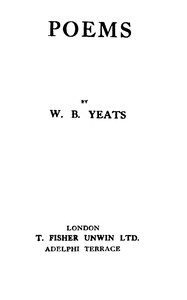
Poems by W. B. Yeats

(4 User reviews)   2516
Yeats, W. B. (William Butler), 1865-1939 Yeats, W. B. (William Butler), 1865-1939
English
Overview: A seminal collection of lyric poetry, this volume charts W.B. Yeats's lifelong artistic evolution from the romantic Celtic Twilight to a hard, mo...
Share

Read "Poems by W. B. Yeats" Online

This book is available in the public domain. Start reading the digital edition below.

START READING FULL BOOK
Instant Access    Mobile Friendly

Book Preview

A short preview of the book’s content is shown below to give you an idea of its style and themes.

trees should be painted in flat colour upon a gold or diapered sky. The walls are of one colour. The scent should have the effect of missal painting._ MARY, a_ woman of forty years or so, is grinding a quern_. MARY What can have made the grey hen flutter so? (TEIG, _a boy of fourteen, is coming in with turf, which he lays beside the hearth_.) TEIG They say that now the land is famine struck The graves are walking. MARY There is something that the hen hears. TEIG And that is not the worst; at Tubber-vanach A woman met a man with ears spread out, And they moved up and down like a bat's wing. MARY What can have kept your father all this while? TEIG Two nights ago, at Carrick-orus churchyard, A herdsman met a man who had no mouth, Nor eyes, nor ears; his face a wall of flesh; He saw him plainly by the light of the moon. MARY Look out, and tell me if your father's coming. (TEIG _goes to door_.) TEIG Mother! MARY What is it? TEIG In the bush beyond, There are two birds--if you can call them birds-- I could not see them rightly for the leaves. But they've the shape and colour of horned owls And I'm half certain they've a human face. MARY Mother of God, defend us! TEIG They're looking at me. What is the good of praying? father says. God and the Mother of God have dropped asleep. What do they care, he says, though the whole land Squeal like a rabbit under a weasel's tooth? MARY You'll bring misfortune with your blasphemies Upon your father, or yourself, or me. I would to God he were home--ah, there he is. (SHEMUS _comes in_.) What was it kept you in the wood? You know I cannot get all sorts of accidents Out of my mind till you are home again. SHEMUS I'm in no mood to listen to your clatter. Although I tramped the woods for half a day, I've taken nothing, for the very rats, Badgers, and hedgehogs seem to have died of drought, And there was scarce a wind in the parched leaves. TEIG Then you have brought no dinner. SHEMUS After that I sat among the beggars at the cross-roads, And held a hollow hand among the others. MARY What, did you beg? SHEMUS I had no chance to beg, For when the beggars saw me they cried out They would not have another share their alms, And hunted me away with sticks and stones. TEIG You said that you would bring us food or money. SHEMUS What's in the house? TEIG A bit of mouldy bread. MARY There's flour enough to make another loaf. TEIG And when that's gone? MARY There is the hen in the coop. SHEMUS My curse upon the beggars, my curse upon them! TEIG And the last penny gone. SHEMUS When the hen's gone, What can we do but live on sorrel and dock, And dandelion, till our mouths are green? MARY God, that to this hour's found bit and sup, Will cater for us still. SHEMUS His kitchen's bare. There were five doors that I looked through this day And saw the dead and not a soul to wake them. MARY Maybe He'd have us die because He knows, When the ear is stopped and when the eye is stopped, That every wicked sight is hid from the eye, And all fool talk from the ear. SHEMUS Who's passing there? And mocking us with music? (_A stringed instrument without._) TEIG...

This is a limited preview. Download the book to read the full content.

Overview: A seminal collection of lyric poetry, this volume charts W.B. Yeats's lifelong artistic evolution from the romantic Celtic Twilight to a hard, modernist brilliance, all while wrestling with the grand themes of love, aging, Irish nationalism, and the search for transcendent truth.

Plot: There is no linear narrative, but a profound journey of the spirit. The poems move from the wistful folklore of "The Stolen Child" to the passionate, unrequited love of the Maud Gonne cycle, through the turbulent political elegies of "Easter, 1916," and finally into the stark, powerful meditations on history and mortality found in his later masterpieces like "Sailing to Byzantium."

Analysis: Yeats earns his classic status through his unparalleled fusion of the personal and the mythic. His technical mastery—from hypnotic rhythms to potent, recurring symbols (the gyre, the tower)—creates a self-contained symbolic universe. More than a poet, he became the architect of a modern Irish consciousness, transforming personal anguish and national conflict into timeless, resonant art that continues to challenge and mesmerize.


⚖️ Public Domain Content

This masterpiece is free from copyright limitations. Distribute this work to help spread literacy.

Charles King
1 year ago

I came across this while browsing and the pacing is just right, keeping you engaged. I couldn't put it down.

Elizabeth Wilson
1 month ago

I came across this while browsing and the character development leaves a lasting impact. Thanks for sharing this review.

Dorothy Ramirez
1 month ago

I stumbled upon this title and the arguments are well-supported by credible references. Exactly what I needed.

Sandra Taylor
4 months ago

Based on the summary, I decided to read it and the plot twists are genuinely surprising. Definitely a 5-star read.
4
4 out of 5 (4 User reviews )

Add a Review

Your Rating *
There are no comments for this eBook.
You must log in to post a comment.
Log in


Related eBooks