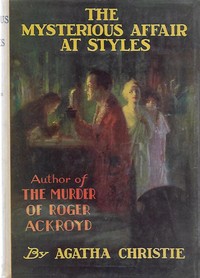
The Mysterious Affair at Styles by Agatha Christie

(8 User reviews)   4424
Christie, Agatha, 1890-1976 Christie, Agatha, 1890-1976
English
Overview: A foundational work of detective fiction, this novel introduces Hercule Poirot and establishes the "country house murder" as a genre staple, expl...
Share

Read "The Mysterious Affair at Styles by Agatha Christie" Online

This book is available in the public domain. Start reading the digital edition below.

START READING FULL BOOK
Instant Access    Mobile Friendly

Book Preview

A short preview of the book’s content is shown below to give you an idea of its style and themes.

As he spoke the last words, we drew up in front of the fine old house. A lady in a stout tweed skirt, who was bending over a flower bed, straightened herself at our approach. “Hullo, Evie, here’s our wounded hero! Mr. Hastings—Miss Howard.” Miss Howard shook hands with a hearty, almost painful, grip. I had an impression of very blue eyes in a sunburnt face. She was a pleasant-looking woman of about forty, with a deep voice, almost manly in its stentorian tones, and had a large sensible square body, with feet to match—these last encased in good thick boots. Her conversation, I soon found, was couched in the telegraphic style. “Weeds grow like house afire. Can’t keep even with ’em. Shall press you in. Better be careful.” “I’m sure I shall be only too delighted to make myself useful,” I responded. “Don’t say it. Never does. Wish you hadn’t later.” “You’re a cynic, Evie,” said John, laughing. “Where’s tea to-day—inside or out?” “Out. Too fine a day to be cooped up in the house.” “Come on then, you’ve done enough gardening for to-day. ‘The labourer is worthy of his hire’, you know. Come and be refreshed.” “Well,” said Miss Howard, drawing off her gardening gloves, “I’m inclined to agree with you.” She led the way round the house to where tea was spread under the shade of a large sycamore. A figure rose from one of the basket chairs, and came a few steps to meet us. “My wife, Hastings,” said John. I shall never forget my first sight of Mary Cavendish. Her tall, slender form, outlined against the bright light; the vivid sense of slumbering fire that seemed to find expression only in those wonderful tawny eyes of hers, remarkable eyes, different from any other woman’s that I have ever known; the intense power of stillness she possessed, which nevertheless conveyed the impression of a wild untamed spirit in an exquisitely civilised body—all these things are burnt into my memory. I shall never forget them. She greeted me with a few words of pleasant welcome in a low clear voice, and I sank into a basket chair feeling distinctly glad that I had accepted John’s invitation. Mrs. Cavendish gave me some tea, and her few quiet remarks heightened my first impression of her as a thoroughly fascinating woman. An appreciative listener is always stimulating, and I described, in a humorous manner, certain incidents of my Convalescent Home, in a way which, I flatter myself, greatly amused my hostess. John, of course, good fellow though he is, could hardly be called a brilliant conversationalist. At that moment a well remembered voice floated through the open French window near at hand: “Then you’ll write to the Princess after tea, Alfred? I’ll write to Lady Tadminster for the second day, myself. Or shall we wait until we hear from the Princess? In case of a refusal, Lady Tadminster might open it the first day, and Mrs. Crosbie the second. Then there’s the Duchess—about the school fête.” There was the murmur of a man’s voice, and then Mrs. Inglethorp’s rose in reply: “Yes, certainly. After tea will do quite well. You are so thoughtful, Alfred dear.” The French window swung open a little wider, and a handsome white-haired old lady, with a somewhat masterful cast of features, stepped out of it on to the lawn. A man followed her, a suggestion of deference in his manner. Mrs. Inglethorp greeted me with effusion. “Why, if it isn’t too delightful to see you again, Mr. Hastings, after all these years. Alfred, darling, Mr....

This is a limited preview. Download the book to read the full content.

Overview: A foundational work of detective fiction, this novel introduces Hercule Poirot and establishes the "country house murder" as a genre staple, exploring themes of deception, inheritance, and the perils of trusting appearances.

Plot: The wealthy Emily Inglethorp is found poisoned in her locked bedroom at Styles Court. With a houseful of potential suspects—each with motive and opportunity—the family calls upon the retired Belgian detective Hercule Poirot, who must sift through a web of false clues and conflicting testimonies to identify the true culprit.

Analysis: Christie’s debut remains a classic not merely for introducing her iconic sleuth, but for its masterful architecture. It is a textbook example of the "fair-play" mystery, presenting all clues to the reader with ingenious misdirection. The plot’s precision and the final, elegant solution demonstrate a formula of narrative control that Christie would perfect, making this the cornerstone upon which the modern whodunit was built.


ℹ️ Free to Use

Legal analysis indicates this work is in the public domain. You do not need permission to reproduce this work.

Amanda Miller
11 months ago

I had low expectations initially, however the author's voice is distinct and makes complex topics easy to digest. I would gladly recommend this title.

Patricia Lee
1 year ago

I have to admit, it provides a comprehensive overview perfect for everyone. I learned so much from this.

Karen Perez
3 weeks ago

Good quality content.

Steven Miller
1 year ago

A bit long but worth it.

Ashley Nguyen
1 year ago

After hearing about this author multiple times, the narrative structure is incredibly compelling. Definitely a 5-star read.
5
5 out of 5 (8 User reviews )

Add a Review

Your Rating *
There are no comments for this eBook.
You must log in to post a comment.
Log in


Related eBooks