1

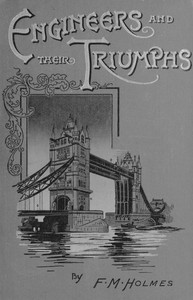
Engineers and their triumphs the story of the locomotive, the steamship, bridge building, tunnel making — Reading Companion
(0 User reviews)
433
Project Gutenberg
2022
Not confirmed
Engineers; Engineering
Readers of public-domain and historical texts
Project Gutenberg digital edition
en
Edition facts
Words
42,157
Reading time
184 min
Text sections
23
The source record for Engineers and their triumphs the story of the locomotive, the steamship, bridge building, tunnel making — Reading Companion measures this digital text at 42,157 words, 3 hr 4 min estimated reading time, and 23 detected text sections.
The text analysis averages about 19.6 words per sentence, while the detected sections provide another way to judge how the source is divided.
Project Gutenberg metadata also associates the work with “Engineers,” connecting these edition facts with the source record’s subject description.
Source:
Project Gutenberg record #69084
An editorial note on F. M. Holmes's 1894 popular history of 19th-century engineering, focusing on how the opening, middle, and later excerpts guide a first reading of the locomotive, steamship, bridge, and tunnel narratives.
Read the complete public-domain text at its original source.
Read on Project GutenbergThe preface of Engineers and their triumphs announces a “purely popular and non-technical” approach, and the excerpts bear this out. Holmes selects four fields—locomotive, steamship, bridge building, tunnel making—and structures each as a chronological story of progress. The opening of the steamship section, for instance, moves from Henry Bell’s Comet to the White Star and Cunard liners of the 1890s, punctuated by specific tonnages, horsepowers, and crossing times. This factual density, combined with occasional dialogue (as in “Before the Furnace”), gives the work a hybrid character: part reference, part narrative.
The Preface as a Roadmap
Holmes’s preface is unusually candid about his sources. He names the Cunard and White Star managers, the firm Maudslay, Sons & Field, and even a letter from Henry Bell published in the Caledonian Mercury in 1816. He also cites a daughter’s testimony to establish Macgregor Laird’s role in founding the British and American Steam Navigation Company. This transparency signals that the book is compiled from contemporary accounts and personal communications, not just library research. For a first reader, the preface thus functions as a guide to the evidentiary base: when Holmes later describes the Britannic’s record voyage or the Campania’s dimensions, those details likely come from company records or press reports. The preface also warns that the four departments were chosen “not in pursuance of any comprehensive plan,” so readers should expect self-contained sections rather than an integrated thesis.
Dialogue as a Rhetorical Device
Chapter V, “Before the Furnace,” opens with a conversation between two unnamed speakers, Jemmy and another man, who discuss the latest Atlantic records. “The record’s broken again, Jemmy!” one exclaims, and Jemmy replies with a prediction about the compound engine. This is the only extended dialogue in the excerpts, and it serves several purposes. It dramatizes the public excitement around steamship speed, personifies the “common man” perspective, and allows Holmes to insert technical commentary (“compound engine”) in a natural voice. The dialogue also creates a temporal bridge: Jemmy’s earlier prediction is said to have been “amply verified,” linking past and present. First-time readers might note that this conversational interlude breaks the otherwise expository tone, suggesting that Holmes occasionally varied his style to maintain interest. The device is used sparingly, so it stands out when it appears.
Numbers as Narrative Drivers
Throughout the steamship excerpts, Holmes deploys precise figures: the Oceanic’s 3600 tons and 3000 horsepower; the Britannic’s crossing of 7 days, 10 hours, 50 minutes; the Paris’s 5 days, 15 hours, 58 minutes; the Campania’s length of 625 feet and tonnage of 12,950. These numbers are not mere decoration—they structure the narrative of progress. Each new ship improves on the last, and the reader is invited to compare times and dimensions. Holmes also includes a rhetorical question: “It was even prophesied that the time across the water might be reduced to six days. How has that been fulfilled?” This implies that the reader should track the fulfillment across the chapter. For a first reading, paying attention to these numerical milestones helps follow the competitive thread between White Star, Cunard, and Inman lines. The numbers also ground the story in verifiable fact, reinforcing the preface’s claim of first-hand information.
The Unseen Whole: What the Excerpts Leave Out
The excerpts cover only the steamship section and the preface. The locomotive, bridge, and tunnel sections are absent, so a first reader cannot assess how Holmes handles those topics. Does he use similar dialogue? Does he rely on comparable numerical progressions? The preface mentions that the four departments were chosen for their “striking features,” but without seeing the others, one cannot know if the steamship narrative is representative. Also missing is any treatment of failures or controversies—the excerpts emphasize triumph. The preface acknowledges that engineering includes roads, canals, docks, and machinery, but those are excluded. A reader should therefore approach the book as a selective celebration, not a comprehensive history. The closing pages of the steamship chapter (not excerpted) might offer a concluding reflection, but the provided text ends mid-sentence with a dash, leaving the narrative unresolved.
For a first reading, begin with the preface to understand Holmes’s evidentiary framework, then move to the steamship chapter to see his narrative method in action. Note how he balances technical data with anecdotal color, and consider whether the other three sections follow the same pattern. The book is best read as a series of independent case studies rather than a unified argument. Let the numbers guide you, but also watch for the occasional human voice that breaks the expository flow.
Holmes’s Engineers and their triumphs hums with the pride of iron and steam, yet its true warmth lies in the everyday lives these marvels quietly serve. That same humble pulse courses through The Municipal and Sanitary Engineer's Handbook — Context and Discussion—sister to the grander tale, speaking of drains and clean water with a patient, sheltering kindness. I’ve often shelved them together, for both know a city’s heart beats below the street.
There are no reviews for this eBook.
There are no comments for this eBook.
Reader reflection
Before you leave, reflect on the book
Use these questions to collect your thoughts before moving on.
Your progress
0
/
10
2
Did this book hold your interest?
3
Would you pass this book on to a friend?
4
How demanding did the text feel?
5
How original did the book feel?
6
How strongly did the book affect you emotionally?
7
How strong was your personal connection to the text?
8
Would a second reading be valuable?
9
What changed or sharpened your thinking?
10