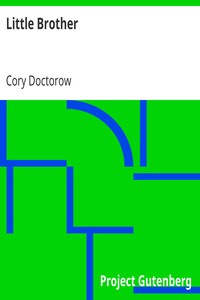
Little Brother by Cory Doctorow

(3 User reviews)   5409
Doctorow, Cory, 1971- Doctorow, Cory, 1971-
English
Overview: A near-future young adult techno-thriller that serves as a modern manifesto for digital civil liberties, positing that privacy is the bedrock of ...
Share

Read "Little Brother by Cory Doctorow" Online

This book is available in the public domain. Start reading the digital edition below.

START READING FULL BOOK
Instant Access    Mobile Friendly

Book Preview

A short preview of the book’s content is shown below to give you an idea of its style and themes.

keyboard in airports, on subways, in taxis -- anywhere I could type. The book was trying to get out of my head, no matter what, and I missed so much sleep and so many meals that friends started to ask if I was unwell. When my dad was a young university student in the 1960s, he was one of the few "counterculture" people who thought computers were a good thing. For most young people, computers represented the de-humanization of society. University students were reduced to numbers on a punchcard, each bearing the legend "DO NOT BEND, SPINDLE, FOLD OR MUTILATE," prompting some of the students to wear pins that said, "I AM A STUDENT: DO NOT BEND, SPINDLE, FOLD OR MUTILATE ME." Computers were seen as a means to increase the ability of the authorities to regiment people and bend them to their will. When I was a 17, the world seemed like it was just going to get more free. The Berlin Wall was about to come down. Computers -- which had been geeky and weird a few years before -- were everywhere, and the modem I'd used to connect to local bulletin board systems was now connecting me to the entire world through the Internet and commercial online services like GEnie. My lifelong fascination with activist causes went into overdrive as I saw how the main difficulty in activism -- organizing -- was getting easier by leaps and bounds (I still remember the first time I switched from mailing out a newsletter with hand-written addresses to using a database with mail-merge). In the Soviet Union, communications tools were being used to bring information -- and revolution -- to the farthest-flung corners of the largest authoritarian state the Earth had ever seen. But 17 years later, things are very different. The computers I love are being co-opted, used to spy on us, control us, snitch on us. The National Security Agency has illegally wiretapped the entire USA and gotten away with it. Car rental companies and mass transit and traffic authorities are watching where we go, sending us automated tickets, finking us out to busybodies, cops and bad guys who gain illicit access to their databases. The Transport Security Administration maintains a "no-fly" list of people who'd never been convicted of any crime, but who are nevertheless considered too dangerous to fly. The list's contents are secret. The rule that makes it enforceable is secret. The criteria for being added to the list are secret. It has four-year-olds on it. And US senators. And decorated veterans -- actual war heroes. The 17 year olds I know understand to a nicety just how dangerous a computer can be. The authoritarian nightmare of the 1960s has come home for them. The seductive little boxes on their desks and in their pockets watch their every move, corral them in, systematically depriving them of those new freedoms I had enjoyed and made such good use of in my young adulthood. What's more, kids were clearly being used as guinea-pigs for a new kind of technological state that all of us were on our way to, a world where taking a picture was either piracy (in a movie theater or museum or even a Starbucks), or terrorism (in a public place), but where we could be photographed, tracked and logged hundreds of times a day by every tin-pot dictator, cop, bureaucrat and shop-keeper. A world where any measure, including torture, could be justified just by waving your hands and shouting "Terrorism! 9/11! Terrorism!" until all dissent fell silent. We don't have to go down...

This is a limited preview. Download the book to read the full content.

Overview: A near-future young adult techno-thriller that serves as a modern manifesto for digital civil liberties, positing that privacy is the bedrock of personal freedom.

Plot: In the aftermath of a devastating terrorist attack in San Francisco, high school hacker Marcus Yallow is wrongfully detained by the Department of Homeland Security. Upon release, he finds his city transformed into a panopticon of surveillance. Using his technological ingenuity, Marcus wages a guerrilla war against the security state, mobilizing his peers to fight back against pervasive monitoring and reclaim their rights.

Analysis: Doctorow’s novel transcends its genre to become a foundational text for the digital age. Its enduring power lies not just in a propulsive narrative, but in its radical, practical ethos: technology is a tool for both oppression and emancipation, and the youth are not just consumers but critical actors. By weaving real-world cryptographic principles and a fierce defense of the Fourth Amendment into its DNA, "Little Brother" educates as it electrifies, making it an essential and alarmingly prescient classic on power, resistance, and the code of citizenship.


📜 Legal Disclaimer

This text is dedicated to the public domain. You do not need permission to reproduce this work.

Deborah Lopez
4 months ago

Simply put, it creates a vivid world that you simply do not want to leave. I couldn't put it down.

Karen Nguyen
4 months ago

To be perfectly clear, the character development leaves a lasting impact. I will read more from this author.

Richard Martinez
5 months ago

Based on the summary, I decided to read it and the author's voice is distinct and makes complex topics easy to digest. Exactly what I needed.

4
4 out of 5 (3 User reviews )

Add a Review

Your Rating *
There are no comments for this eBook.
You must log in to post a comment.
Log in


Related eBooks