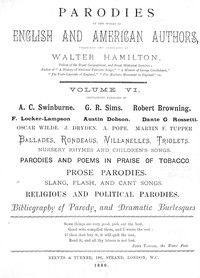
have afforded――Messrs. Cuthbert Bede, G. H. Brierley, of Cardiff; F. W. Crawford, T. F. Dillon Croker, Frank Howell, J. H. Ingram, Walter Parke, F. B. Perkins, of San Francisco; C. H. Stephenson, C. H. Waring, and Gleeson White. In nearly every case the permission of the authors has been obtained for the re-publication of their Parodies; in the few instances where this was not done, it was owing to the impossibility of finding the author’s address. During the progress of the work, some further Parodies appeared of Authors already dealt with, it is proposed to include these in a supplementary volume, which will be published at some future date. It is believed that the ample Bibliographical information relating to Parodies and Burlesques contained in this volume will be specially useful to Librarians, Managers of Penny Readings, and Professors of Elocution. Editors of Provincial Papers who offer prizes for Literary compositions should be on their guard against unscrupulous persons who copy Parodies from this Collection, and send them in as _original compositions_. In much of the compilation, and especially those portions requiring the exercise of taste, and in the somewhat dreary process of proof reading, I have been greatly assisted by my wife, whose cheerful co-operation in all my labours adds just the zest which renders Life worth living. Whilst bidding my subscribers _Farewell_, I wish to add that the subject of Parodies will continue to engage my attention, and that I shall always be grateful for any information, or examples, that may be sent to me, addressed to the care of Messrs. Reeves and Turner. WALTER HAMILTON. CHRISTMAS, 1889. Algernon Charles Swinburne. ―――― [Illustration: M]r. Swinburne, son of Admiral Charles Henry Swinburne, and grandson of Sir John Edward Swinburne, sixth baronet, was born in 1838, and educated first at Eton, and afterwards at Oxford. Despite his ancient pedigree, his aristocratic connections, and his university education, the early writings of Mr. A. C. Swinburne, both in prose and verse, were coloured by Radical opinions of the most advanced description. Byron, Shelley, Wordsworth and Southey commenced thus, with results which should have taught him how unwise it is for a poet, who wishes to be widely read, to descend into the heated atmosphere of political strife. _The Undergraduate Papers_, published by Mr. Mansell, Oxford, 1857-8, contained some of Mr. Swinburne’s earliest poems, these were followed by “Atalanta in Calydon,” “Chastelard,” and “Poems and Ballads.” It will be readily understood that only a few brief extracts can be given from Mr. Swinburne’s poems, sufficient merely to strike the key notes of the Parodies. ―――― THE CREATION OF MAN. Before the beginning of years There came to the making of man Time, with a gift of tears; Grief, with a glass that ran; Pleasure, with pain for leaven! Summer, with flowers that fell; Remembrance fallen from heaven, And madness risen from hell; Strength without hands to smite: Love that endures for a breath; Night, the shadow of light, And life the shadow of death. And the high gods took in hand Fire, and the falling of tears, And a measure of sliding sand From under the feet of the years: And froth and drift of the sea; And dust of the labouring earth; And bodies of things to be In the houses of death and of birth; And wrought with weeping and laughter, And fashioned with loathing and love. With life before and after, And death beneath and above, For a day and a night and a morrow, That his strength might endure for a span With travail and heavy sorrow, The holy spirit...
This is a limited preview. Download the book to read the full content.



Brian Taylor
1 year agoGood quality content.