1

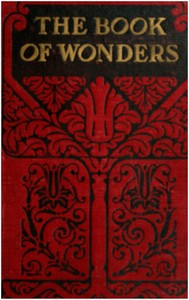
The book of wonders — A Closer Reading
(0 User reviews)
1387
Project Gutenberg
2025
Not confirmed
Encyclopedias and dictionaries; Science -- Miscellanea; Curiosities and wonders; Questions and answers; Technology -- Miscellanea
Readers of public-domain and historical texts
Project Gutenberg digital edition
en
Edition facts
Words
251,539
Reading time
1094 min
Text sections
54
The source record for The book of wonders — A Closer Reading measures this digital text at 251,539 words, 18 hr 14 min estimated reading time, and 54 detected text sections.
The text analysis averages about 21.1 words per sentence, while the detected sections provide another way to judge how the source is divided.
Project Gutenberg metadata also associates the work with “Encyclopedias and dictionaries,” connecting these edition facts with the source record’s subject description.
Source:
Project Gutenberg record #75948
An editorial note on the language, narrative voice, and pacing of Rudolph J. Bodmer's 1914 compendium, which answers everyday questions with plain, simple answers and a fatherly tone, shifting from childlike wonder to historical exposition.
Read the complete public-domain text at its original source.
Read on Project GutenbergRudolph J. Bodmer's The Book of Wonders (1914) opens with a striking claim: "No truly great book needs an explanation of its aim and purpose." Yet the editor immediately provides one, recounting how the work "began with the attempt of a father to answer the natural questions of the active mind of a growing boy." This framing establishes a conversational, paternal voice that persists throughout the volume. The language is deliberately plain, as the subtitle promises "plain and simple answers" to "thousands of everyday questions." The prose shifts between direct, child-directed explanations and more formal historical passages, creating a distinctive rhythm that mirrors the maturation of the child's curiosity described in the introduction.
A Fatherly Voice and Its Rhetorical Patterns
The editorial voice in The Book of Wonders is consistently that of a patient, knowledgeable father figure. This is evident in the recurring use of second-person address and rhetorical questions that mimic a child's curiosity: "Can you tell What happens when we telephone? How a telegram gets there?" The answers are structured as straightforward explanations, often beginning with a simple statement before expanding. For instance, the section on lamps opens with "It is probable that the earliest lamps were nothing more than convenient vessels, filled with oil and fired by means of rushes." This pattern—starting with a concrete, almost tangible image—anchors the reader before moving into more detailed historical or technical information. The voice remains consistent even when the subject matter becomes complex, maintaining a tone that is instructive without being condescending.
Shifts in Pace: From Childlike Wonder to Historical Exposition
The pacing of the text varies markedly between sections. Early passages, such as the introduction, move quickly through a series of rapid-fire questions: "What makes it night?" "Where does the wind begin?" "Why is the sky blue?" This staccato rhythm mimics the relentless curiosity of a child. In contrast, later sections—like the history of lamps—adopt a slower, more deliberate pace, weaving together archaeological evidence, classical references, and cultural anecdotes. The description of Roman street lighting, for example, builds a vivid picture: "Even Rome, at the height of her luxury and beauty, rarely exhibited more than one or two lanterns in her streets." The prose lingers on details, such as the use of "pine splinters, the torch and the flambeau" among the Romans, creating a sense of historical depth. This shift in tempo reflects the book's dual purpose: to satisfy immediate curiosity and to provide a broader educational context.
Recurring Details and Structural Repetition
Certain structural elements recur throughout the excerpts, reinforcing the book's encyclopedic nature. Each topic is introduced with a question in the heading, such as "What Were the Earliest Lamps?" or "When Were Street Lamps First Used?" The answers then follow a predictable pattern: a brief, direct response, followed by historical or technical elaboration. This repetition creates a rhythm that guides the reader through the vast array of subjects. Additionally, the text frequently references classical authors like Herodotus and Pliny, grounding modern wonders in ancient precedents. The mention of "the lamps of the wise and foolish maidens" ties biblical imagery to material culture, while the description of "the first street light in America" connects the historical narrative to the New World. These recurring details—lamps, light, and the contrast between ancient and modern—serve as thematic threads that unify the diverse entries.
Readers approaching The Book of Wonders should attend to the interplay between its simple, question-driven structure and the more expansive historical narratives that follow. The editor's voice—at once paternal and scholarly—shapes the reader's experience, guiding them from immediate curiosity to broader understanding. The shifts in pace, from rapid-fire queries to measured exposition, reward careful reading. This is a work that invites browsing, but its true value emerges when one pauses to trace the connections between the everyday and the extraordinary.
There’s something tender in how Bodmer lets a child’s question open into slow, patient history—the way he trusts that wonder doesn’t need rushing. It reminds me of an old Spon catalogue I once handled, full of practical manuals for things we’ve since forgotten to ask about. Books Relating to Applied Science, Published by E & F. N. Spon, 1887. — Key Ideas to Explore sits nearby on my shelf, and I sometimes flip through both, missing that gentler certainty.
There are no reviews for this eBook.
There are no comments for this eBook.
Reader reflection
Before you leave, reflect on the book
Use these questions to collect your thoughts before moving on.
Your progress
0
/
10
2
How did the book work for you overall?
3
Would you pass this book on to a friend?
4
How much effort did this book require?
5
How did the pace of the book feel?
6
Could you apply anything you learned?
7
How well did it match your expectations?
8
Did any part of the book feel personally relevant?
9
What changed or sharpened your thinking?
10